Why reverberation is killing the planet

Kristin and I were talking about the BP oil spill this weekend, and I had some thoughts:

  • In the Seattle area, much of the business nowadays is high tech. The actual work is done on a computer. Theoretically, there is no reason this couldn’t be done on a laptop at home.
  • However, most people still commute into work 5 days a week. At many jobs, at least 1/2 the day is spent in meetings.
  • If people were able to attend at least some of these meetings remotely, this would greatly cut down on the amount of commuting that is necessary. In addition, a lot of business trips could be avoided. This would greatly reduce the amount of fossil fuels used around here.
  • Yet people hate attending meetings remotely. The reason that is always cited: It is usually difficult to impossible to understand what is being said by the people in the conference room.

Let’s look at a typical conference room (and if you haven’t experienced this situation in your business life, consider yourself lucky). There is a large table, made of a hard material like wood or Formica. There is a single conference phone in the middle of the table, which acts as both speaker and microphone. The conference phone is connected to the outside world via phone lines, which have a 4 KHz bandwidth, mono. The conference phone usually shares the table with a number of laptops, each with their own fan, and is often located close to  The room usually has at least 1 wall that is highly reflective to sound, due to a whiteboard being there. In addition, it is common to have one wall be made of glass windows to the outside world (or to elsewhere in the office). Glass reflects sound to a greater degree than your typical drywall found in offices.

The resulting sound is HORRIBLE, especially when you dial into the meeting. The room is reverberant, the table is reverberant, and the fans from the laptops and projector add a noise floor that the reverberant voices need to be heard above. People that are not right next to the conference phone have their voices swallowed by the early reflections. Compressing all of this info into a mono 4KHz stream makes it difficult to differentiate one voice from another – for the people in the room, the spatial information from both ears allows them to discriminate between sound sources.

To add insult to injury, the codecs used by the phone companies for voice transmission assume that the sound they are transmitting comes from a single human voice. Instead of transmitting a downsampled version of the voice, the codec separates the voice into a number of filter coefficients (representing the resonances of the vocal tract) and a “residual” signal that is used to excite the filter coefficients at a given pitch (representing a glottal pulse from the larynx). Trying to transmit several voices speaking at the same time through this model would be like a single person trying to speak in several voices at once, and adding reverb to each of these voices. The result would be a burbling, blippy mess, which anyone who owns a cell phone would instantly recognize.

What is the point of my rant? I believe that if corporations prioritized high-quality audio reproduction and transmission for meetings, then the number of meetings that people have to drive and/or fly to could be greatly reduced. The primary mode of real-time communication between people is speech. The current phone networks are designed around the assumption that speech is being transmitted between two people, and the bandwidth and codecs used for this transmission are inadequate for communication between groups of people, where many of those people share the same acoustic space.

In order to allow conference calls to be tolerable, the issue of reverberation within the conference room needs to be dealt with. There are a variety of solutions that would improve the situation:

  • Conference rooms could be acoustically treated. Adding sound absorbing panels can cut down reflections from a wall.
  • More microphones can be used, of higher quality. By having microphones closer to the people speaking, the ratio of direct to reverberant sound can be increased.
  • People can use individual wireless headsets. This would put the microphone for each person at an ideal location (i.e. right in front of their mouth), largely eliminating the influence of room reverberation. In addition, this would eliminate the need for a speaker in the room, which gets around the feedback issues that can happen with speakerphones.
  • Instead of using phone lines, the audio codec could be built into software that allows audio and video conferencing. This allows the codec to be optimized for transmission of several simultaneous voices, without being squeezed into a 4KHz bandwidth. A higher bandwidth stereo codec, such as MP3 or AAC, would allow easy localization and discrimination of voices within the typical conference room environment.

None of the technology described above is new or radical. The big change in the corporate world would be the prioritization of audio quality, as a way of making online meetings a viable alternative to in-person meetings. If corporations were encouraged to switch over to online meetings, as a way of reducing fossil fuel consumption, the need for higher quality acoustics and codecs would become immediately apparent. Better acoustics = better world.
ValhallaFreqEcho, Binaural Beats, and “The Strange Mechanism”

A recent Gearslutz thread brought up an idea that I haven’t thought of in a long time: Binaural Beats.

The basic idea behind binaural beats is that if you have separate frequencies presented to the left and right ears, a beating sound will be perceived that is generated by the brain, as opposed to any physical process. For example, if you have a 300 Hz sine wave in the left ear, and a 310 Hz sine wave in the right ear, a beat frequency of 10 Hz would be perceived.

It has been postulated that binaural beats can be used for brainwave entrainment, where the brainwave frequencies fall in step with a given frequency. By doing so, the brain is supposed to enter into different states, corresponding to different rates of EEG activity. There have been a number of devices and sound files over the years that are designed to help listeners enter into a more desirable range of brainwave frequencies, such as alpha or theta.

I have to admit that I view the whole idea of binaural beats, or any specific audio patterns or tempos, as a method of inducing some mystical brain state with a fair degree of cynicism. Gilbert Rouget, in Music and Trance, discusses what anthropologist Jean Rouch has labeled the “strange mechanism.” The concept behind “the strange mechanism” is that the rhythms found in the music used during ceremonies associated with the trance state, such as Haitian voodoo, can directly trigger the transition to the trance state, through a process known as auditory driving. This flies in the face of the analysis of music found in trance-associated ceremonies, where the tempo of the music can vary wildly from culture to culture, and indeed within the same ceremony.

The auditory driving concept became popular during the early 1990’s, as rave culture exploded in popularity. The specific tempos found in the techno of the time were supposed to be the exact frequency needed to induce altered states of consciousness, and such ideas are still associated with trance music. To me, this is ignoring the other factors that often were at play in such circumstances, like MDMA, LSD, mushrooms, speed, cocaine, ketamine, robo, etc. It seems more likely to me that the rave “trance” state was just as culturally specific as trance states in other cultures, and not due to any magic properties of a given drum beat or tempo.

It is ironic that, considering my skepticism around the whole topic of binaural beats and auditory driving, I have produced a device that is ideal for experimenting with binaural beats. ValhallaFreqEcho can easily be set up to take any audio source, and produce a binaural beat pattern. Here’s how you do it:

  • Set up the audio source in the DAW of your choice. On Macs, you can use Soundflower to stream audio from iTunes into a DAW.
  • Instantiate ValhallaFreqEcho on the desired track
  • Set Mix to 100% wet (1.0), Delay to its shortest value, Feedback to zero, LowCut to its minimum value, HighCut to its highest value, and output mode to stereo.
  • Set Shift to the desired beat frequency. Note that a given frequency shift will result in a beat pattern of 2X the frequency shift. Example: a 2 Hz frequency shift will raise frequencies in the left channel by 2 Hz, and the right channel by 2 Hz, resulting in a beat pattern of 4Hz.
  • For Theta waves, set the frequency shift between 2 and 3.5 Hz.
  • For Alpha waves, set the frequency shift between 4 and 6 Hz.

Voila, trippy music for trippers! For added fun, set the delay to the desired length or tempo subdivision, and turn up the feedback. This will produce an echo that swirls around your head. Tune the swirl rate for the desired brainwave entrainment. Or, have the swirl rate (i.e. frequency shift) change rate during the track, to induce listeners to smoothly transition between different brainwave frequencies.

You can also use ValhallaFreqEcho to generate binaural beats without the use of any input signal. Just turn the feedback up to a high level, and play with the delay time, low cut, and high cut controls to produce self-oscillating echos that spin through your skull.

Will this trigger “the strange mechanism”? I dunno. I have found myself listening to ValhallaFreqEcho in some self oscillating mode late at night, suddenly aware that I have no idea how much time has passed. I just chalk this up to spending too much time in front of a compiler, or getting old, but maybe there is something deeper going on there.  Try it out for yourself.*

*ValhallaDSP takes no responsibility for inducing seizures, murderous states, or becoming one with the all-seeing Eye at the center of the universe, through the use of ValhallaFreqEcho.

EDIT: Here is a quick video clip of ValhallaFreqEcho in binaural mode:

All Hail Harmonia!!!

I’m deep inside the plugin mines right now, working on the next Valhalla DSP release. So here’s a quick tribute to one of the bands that got me interested in this whole electronic music thing in the first place: Harmonia.

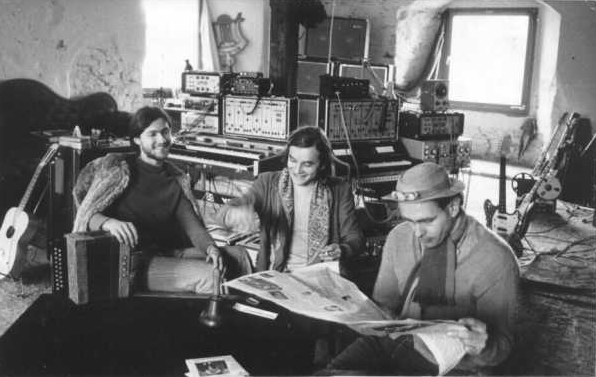
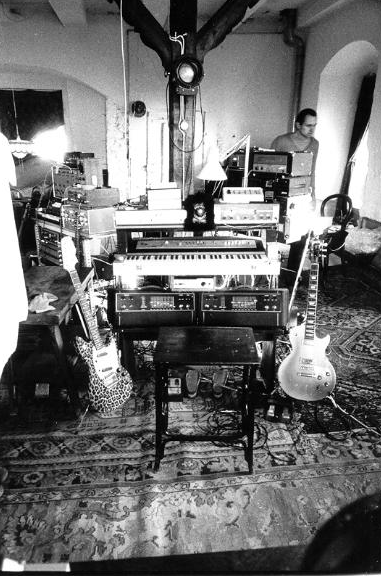
Harmonia was a “supergroup” of sorts, consisting of Michael Rother (1/2 of NEU!), and Hans-Joachim Rödelius and Dieter Moebius (2/2 of Cluster). In 1973, Rother, Roedelius and Moebius moved to the rural village of Forst, West Germany, where they built the coolest studio I have ever seen in some ancient farmhouse or barn or something. Seriously, every picture I have ever seen of this place makes me want to move out to the country and buy up some old test equipment:

Here’s another shot of Micheal Rother’s setup:

Harmonia’s first album, titled Musik von Harmonia, was released in 1974, and is simply essential. The tracks consisted of the same tentative, snaky interlocking parts that characterized Cluster’s music of the time, with Rother contributing beautiful sustained fuzz tones:

In 1975, Harmonia released Deluxe. This album drew more heavily upon the “motorik”* beat that characterized NEU!, and the melodies were a bit more “soaring.” This album gets heavy rotation while I am coding new algorithms:

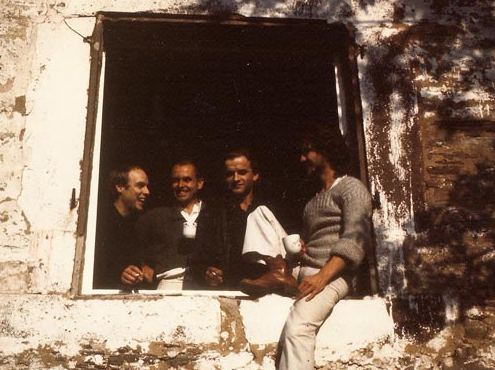
Harmonia went on hiatus after Deluxe, but had a brief reunion in Forst in September 1976, where they were joined by Brian Eno. The resulting tracks were released in 1997, on Tracks and Traces. Again, the photos from the studio are incredible:

The music is very close to the first collaboration between Cluster and Eno. Good stuff:

Anyway, go get these recordings. There is a live album from 2007 that is pretty great as well, but the first two studio recordings are essential.

* The rock critic term for the highly repetitive “buh-buh-BUH-buh-buh-buh-BUH-buh” beat that was used by NEU! in their faster songs, as well as by Kraftwerk and other Krautrock-influenced bands. Personally, I think it should be called a “Moe Tucker” beat, as she made heavy use of it during her tenure in the Velvet Underground.

Early tape loop experiments with Eno, Fripp, Terry Riley, and Pauline Oliveros

As a huge Eno fan, I was always fascinated by the idea of Frippertronics. This process (made famous by the album (No Pussyfooting) by Brian Eno and Robert Fripp) used two tape decks, situated a small distance from each other. The tape travels from the supply reel of the first machine to the take-up reel of the second machine. In addition, the sound is recorded on the first machine, and played back on the second machine. By adjusting the distance between the machines, and by feeding the output of the second machine back to the record head of the first machine, very long delays can be achieved (on the order of several seconds), where the delays feedback away at a very slow rate. Put the right input into such a system, and the result can be very ethereal:

Delving deeper into the history of looping, I found that Eno and Fripp’s work had been preceded (by a good decade) by the work of Terry Riley. Riley had first used the feedback tape loop technique in 1963, in “Music for ‘The Gift'”:

In this piece, Riley fed recordings of the Chet Baker Quartet into a tape loop system, to create a disorientating effect. Several years later, Riley would use a feedback tape loop system to create improvisations with a Farfisa organ, as featured in “A Rainbow in Curved Air”:

Pauline Oliveros also experimented with feedback tape loops. In her 1965 composition, “Bye Bye Butterfly,” Oliveros made use of swept oscillators (and the difference tones between them), tape echo, and classical snippets to create a dense, beautiful ambiance:

It is interesting to contrast Oliveros early electronic work with her performances with the Deep Listening Band (as described in a previous blog post). Both the early electronic work and the later acoustic work create sustained sound through the use of delay and reverb, but Oliveros’ current work relies upon the lengthy reverb of unusual acoustic spaces.

Ambient reverb, no electronics required: The Dan Harpole Cistern at Fort Worden

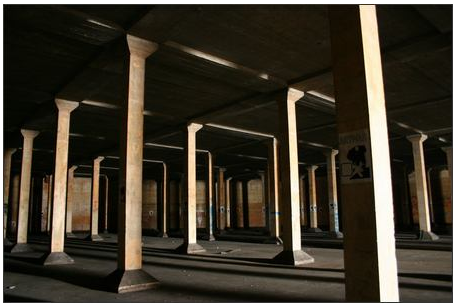
During the past few decades, a number of musicians have taken advantage of the unusual acoustics to be found at a WWII-era water cistern at Fort Worden State Park in Pt. Townsend, Washington. This cistern, now dubbed the Dan Harpole Cistern, once held 2 million gallons of water, but is now empty, and is distinguished by a 45 second reverberation decay.

Artists such as Stuart Dempster and Pauline Oliveros have recorded within the space, creating music that sounds like electronic ambient music, but is entirely generated from acoustic instruments such as trombones, accordions, and conch shell trumpets. The two artists have collaborated in the Deep Listening Band, which specializes in music performed in naturally reverberant spaces.

A few videos of music performed within the space:

The distorted sound quality of these videos doesn’t do justice to the sonics heard on the recordings of Stuart Dempster and the Deep Listening Band, so I highly recommend seeking those out.

Performing music in such a space requires the performer to tailor their music to the unique reverberant qualities. Fast notes turn into a blur, while held notes will sustain seemingly forever – not long enough to really be forever, but long enough to suggest eternity while allowing the music to transform over time.

Archaeology meets DSP: CCRMA at Chavín de Huántar

In 2008, a team of researchers from CCRMA at Stanford University traveled with Professor John Rick to Chavín de Huántar in Peru. The purpose of the joint expedition was to measure and archive the unusual acoustics found on the site, as detailed in my previous blog post.  The team of investigators from CCRMA consisted of some notable luminaries from the fields of computer music and audio DSP, including Julius Smith (pioneer of waveguide synthesis), John Chowning (pioneer of FM synthesis), Perry Cook (expert in physical modeling), and Jonathan Abel (co-founder of Universal Audio, created many of the algorithms used in the UAD1 and UAD2).

The preliminary results from the expedition can be found at the website of the Chavín de Huántar Archaeological Acoustics Project. I highly recommend visiting the CCRMA site, and tracking down the various papers. A brief summary of the published results:

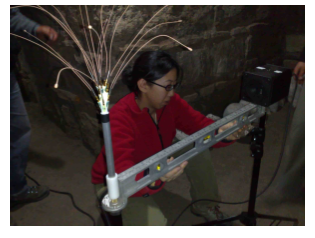
The CCRMA researchers brought a a novel microphone array to Chavín, to capture the impulse response of the galleries. The microphone array was specifically developed for room acoustics analysis and synthesis, and archaeological acoustics applications., and an overview of its design and construction was presented in an AES Conference paper, “A Configurable Microphone Array with Acoustically Transparent Omnidirectional Elements.” The new device consists of a number of omnidirectional microphone elements, mounted on flexible wire mounts, attached to a lightweight yet sturdy base that is suited for the narrow tunnels found at Chavín.

The microphone array is used in conjunction with a calibration system, which consists of 4 small speakers that are configured around the base of the microphone array:

By sending calibration signals through the speakers and processing the results, the various time differences between the microphone elements can be compensated for. The system is purported to obtain better results at capturing impulse responses of various structures than the previous microphone arrays that have been used.

The initial analysis of the acoustics at Chavín, recorded with a simpler microphone/monitor setup than described above, was published in a paper presented at Acoustics ’08 in Paris, “On the Acoustics of the Underground Galleries of Ancient Chavín de Huántar, Peru.” The researchers found that the reverberation times at Chavín were fairly short, on the order of 150 milliseconds to around 1 second. The paper suggests that the short reverb times would work for the rhythmic playing of the Strombus trumpets found on site. The reverb time increases as a function of the number of turns between the source and the receiver, with sources several gallery turns away from the receiver having a longer perceived reverb time.

The reverberation in the Chavín galleries is characterized by dense and energetic early reflections, and low inter-aural cross-correlation. All 3 of the galleries have a quick onset, where the reverberation reaches Gaussian statistics within 20 milliseconds of the initial impulse. The quick build to Gaussian (i.e. random) statistics, and the low amount of cross-correlation between the left and right ears, is responsible for the strange sonic characteristics of the galleries, where it is difficult to localize where a signal is coming from in the absence of a direct signal. David Griesinger, the pioneering DSP guru behind the original Lexicon algorithms in the 224/XL and the 480L,  has discussed the role of low inter-aural cross-correlation, or decorrelation, in creating a sense of envelopment, where the sound is perceived as surrounding the listener. In artificial reverberators, decorrelation is obtained by having different delay times or phases for the different output signals. At Chavín, the small distance between structural surfaces is probably responsible for the quick build of echo density to the late field, which demonstrates randomness down to the binaural level.

The acoustics research and analysis of Chavín is ongoing. There are a few issues which I feel would be interesting to address in future publications:

  • The galleries at Chavín were originally covered with plaster. It is possible that the original plaster would create a dramatic difference in the RT60 of the galleries. An example would be a small room made of wood, versus the same room covered in several coats of cement plaster – the latter describes the famous reverberation chambers at Gold Star Studios. The CCRMA website mentions that research will be conducted into the sonic effects of the plaster used at Chavín.
  • The analysis of the galleries at Chavín used a long swept exponential sinusoidal test signal for the impulse. Such a signal is useful in reducing the effects of noise on the analysis, but it also “smooths out” any time variation that might have been present in the original reverb response. It would be interesting to analyze the reverb of the galleries, to see if time variation would have any marked acoustic effects. The temperature of the galleries has been measured as fairly constant, but this is probably assuming modern sources of light, such as flashlights, as opposed to torches or the like. In addition, the presence of living bodies in a small space can have marked effects on the air temperature, which can result in small changes in the speed of sound that have a noticeable effect on the sidebands of a signal in the late reverb decay. The current reverberation time in the galleries is short enough that small variations in the speed of sound may not have a significant effect. However, the longer reverb times that may be associated with the original plastered walls may have allowed for time variation to be perceivable in the reverb decay, especially as heat sources are introduced into the gallery.

As a fitting end to this post, here is a video of Tita la Rosa playing a Strombus trumpet, presumably within one of the galleries at Chavín:

[vimeo http://vimeo.com/7324065]

Conch trumpets, hallucinogenic cacti, and ancient reverb: Chavín de Huántar

Chavín de Huántar is an archaeological site in the Peruvian Andes, where a major temple complex has existed for several thousand years. The site has a number of temples and ceremonial plazas, and is honeycombed with corridors, shafts, and drains built of stone block. It is currently believed that construction of the major ceremonial buildings began around 900 BCE, and ended around 600 BCE. The non-ceremonial archaeological sites surrounding the main temple complex show signs of an emerging social stratification during the period that Chavín was active as a ceremonial center.

Professor John Rick of Stanford University (who was my undergraduate adviser in Anthropology) has been conducting research at Chavín since 1995. Rick has recently published several papers that put forth a provocative theory: that the structures at Chavín were used in rituals where the dominant “priests” (or whatever class was in power) relied on sensory manipulation, in combination with hallucinogenic drugs, to reinforce the perception that they had supernatural authority. This perceived communication with the gods, or godlike nature of the dominant class, would serve to justify and perpetuate the social stratification that was emerging at Chavín.

In his 2005 paper, The Evolution of Authority and Power at Chavín de Huántar, Peru, Professor Rick lists the evidence that the structures at Chavín were used as part of a “Tradition-Based Convincing System.” A brief summary of his arguments from this paper and other papers follows (all images are sourced from this paper).

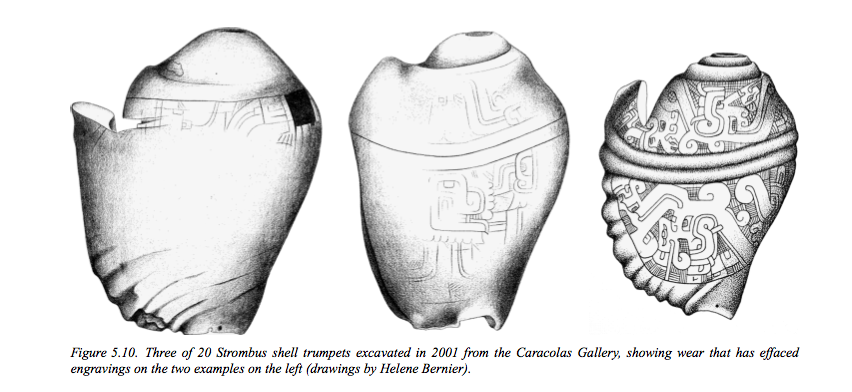
The stone passages known as galleries have very unique sonic characteristics, where sounds are difficult to localize. Within these galleries, Rick recently excavated a number of decorated trumpets, carved from the Strombus conch:

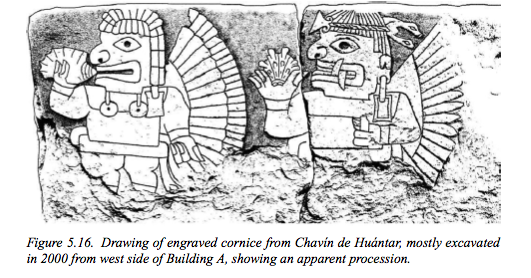
The Strombus conch shells have been used as musical instruments in Peru for several thousand years, as depicted in this artwork drawn from a cornice at Chavín:

Along the Peruvian coast, conch were used as food (and still are to this day, and taste delicious in soup, especially if the soup has a spicy coconut-onion base). However, Chavín is a fair distance from the coast, so the presence of ornately carved conch shells there points to a society that had extensive trade associated with ceremonial practices.

The galleries are marked by ducts known as ventilation shafts and drainage canals, but these ducts seem poorly designed for this proposed usage. In 1976, Luis Lumbreras published a paper, Acerca de la función del sistema hidráulico de Chavín, where he argues that the “drainage canals” were used primarily for sonic purposes. When water was pored into these canals, the galleries below were filled with a roaring sound.

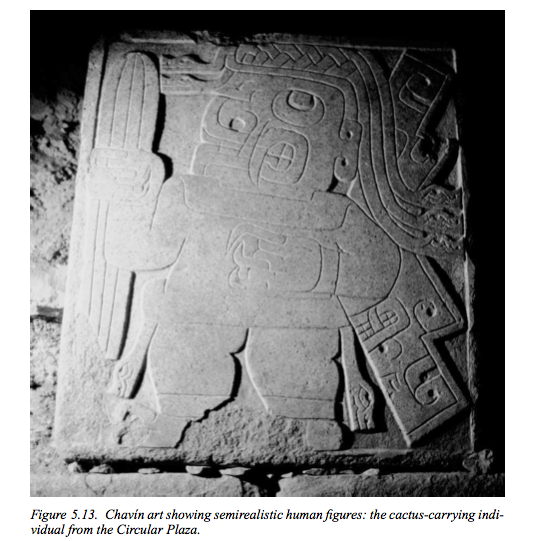
There is a fair amount of evidence at Chavín for the use of psychoactive drugs, in particular the San Pedro cactus, or Echinopsis pachanoi. This tall columnar cactus is native to the Andes, and there is evidence that San Pedro been used in rituals in the region for over two thousand years. At Chavín, the distinctive ribbed shape of the San Pedro cactus can be seen in carved figures:

Chavín also has a number of carvings of semi-humanoid, semi-animal figures. Such figures may represent the shamanistic transformation of a person into an animal spirit. Rick argues that such figures represent an “exceptionally graphic depiction of the drug effects and transitions.”

A summary of how Professor Rick thinks the ritual may have proceeded, from a recent profile of his work:

The ritual would have begun, most likely, by ingesting a hallucinogenic powder or a liquid extracted from the San Pedro cactus. As the Chavín subjects walked through the dark, cramped halls, the sound of Strombus trumpets echoed around them from some unseen source. Water roared through canals beneath their feet (or, strangely, overhead), producing a heavy percussion amplified by the drugs. Mirrors placed in ventilation ducts to reflect the sun poured brilliant shafts of light into the subterranean hallways, only to be “turned off,” thrusting the occupant into blackness as dark as obsidian. By the time the subjects emerged from the chambers, staggering and stunned, their perspective had been altered forever. The unmistakable impression: somebody powerful was in charge.

The descriptions of the sonic qualities of Chavín are fascinating; however, it is hard to quantify such qualities from words alone. Clearly, the galleries have unusual reverb characteristics. In the next post, I will discuss a recent expedition to Chavín, where Professor Rick was joined by a number of prominent figures in audio DSP and computer music in order to capture and analyze the reverberant qualities of the galleries.

Busy day today, so here’s a bunch of David Bowie and Iggy Pop videos

I’m preparing a really cool blog post in the archaeo-acoustics vein, but I’m running out of time in the day. So, here’s a bunch of David Bowie and Iggy Pop videos from the 1976 to 1979 time frame (the Berlin years) to tide you over.


[dailymotion id=x7nzkv]


Caves, megaliths, and reverbs in the prehistoric world

I have a confession to make: I was an Anthropology major. I took some courses at CCRMA as an undergraduate, but my degree was in Anthropology, with a focus in archaeology. Instead of studying the types of things that make up my work nowadays, like electrical engineering and computer science, I spent my time learning about the relationship of environment to culture, hunter gatherers from an ecological perspective, the societies of Central and South America, the interaction between the fur trade and religion in Subarctic Canada, stuff like that. My favorite book from that era (or, at the very least, the book with the best title):

So it should come as no surprise that I am fascinated by the sounds of ancient buildings, caves, and other prehistoric constructions and dwellings. The study of ancient acoustics, or archaeoacoustics, covers a variety of sonic phenomena of the prehistoric world, from research into early musical instruments such as bone flutes and percussion instruments, to the possibility of whether grooves in pottery could have recorded sounds from thousands of years ago.

A number of books have been published on the subject of archaeo-acoutics. Paul Devereux, in “Stone Age Soundtracks: The Acoustic Archaeology of Ancient Sites,” provides a high-level summary of the different theories. A recent publication, “Archaeoacoustics,” edited by Chris Scarre and Graeme Lawson, collects a number of articles with a more scholarly bent. Barry Blesser and Linda-Ruth Salter provide an overview of the topic in “Spaces Speak, Are You Listening?” As far as web resources, the Acoustics and Music of British Prehistory Research Network provides an excellent bibliography and set of links to current research projects.

There are a lot of cool theories that have been posited in the last few decades in the archaeo-acoustic field. David Lubman has described how handclaps reflecting off of the staircase of a Chichen Itza pyramid are transformed into a chirping sound very close to the call of the quetzal. Aaron Watson and David Keating have conducted experiments in burial mounds throughout the British Isles, and found that the chambers tend to have a Helmholtz resonance in the 1 Hz to 7 Hz range. Watson and Keating experimented with drumming at a tempo that matched the frequency of the Helmholtz resonances, and have argued that the resulting infrasonics caused subjective effects in listener, such as elevated pulse rates and breathing. Robert Jahn and Paul Devereux have found that many chambered megalithic tombs had strong resonance frequencies in the 95 to 120 Hz range, which corresponds with the low baritone range of the human voice, and that exposure to this frequency could cause changes in brain activity that correspond to meditative and trance states.

Some of the theories, in my opinion, fall under the category of “just-so stories.” Great ideas, cool to think about, and absolutely unprovable. Without the use of a time machine, we have no idea what type of music was being played 20,000 years ago. It is safe to assume that people in the Paleolithic era were reacting to their sonic environment, as the caves and megaliths that ceremonies were (presumably) performed in have quite striking sonic characteristics. Beyond that, if there is no evidence of musical instruments on the site, there is very little evidence of what sorts of sounds were being made within these environments, all talk of resonances and infrasound aside.

While the evidence for what sounds were produced in prehistoric sites is often scant, there is strong evidence of awareness of striking acoustic characteristics in prehistoric times. Iegor Reznikoff has studied the location of Paleolithic art in European caves, and has found a strong correlation between the presence of art or distinctive markings in a given location, and the quality of the resonance in those locations. The resonance was most marked in niches or recesses that were decorated, and Reznikoff argues that it is inconceivable that the person(s) decorating these spaces would not have noticed the striking sonic quality of the space. Steven Waller has found a similar degree of correlation between the placement of rock art, and the distinctiveness of the echos within those locations. It may not be possible to know what sounds were being made thousands of years ago, but there is a fair amount of evidence that our ancestors had strong preferences about where these sounds were made.

In the next blog post, we’ll skip ahead a few thousand years, to discuss recent research conducted on the acoustics of a South American ceremonial site, and how the sonics of that site may have factored into societal control.

Reverberation decay of concrete structures, as applied to hair metal

In 1988, I saw the Monsters of Rock tour at the Seattle Kingdome. For the most part, the bands that performed were hair metal at their finest: Kingdom Come, Dokken, Scorpions, Van Halen. Metallica also played a set, which was good in a non-ironic sense.

What wasn’t good about the show: the sound. The Kingdome was notorious for having horrible acoustics, with a HUGE reverb decay – I have seen it estimated at between 9 and 10 seconds for low frequencies. This is roughly comparable to a large stone cathedral, or to Eos at its longest setting. The enormous reverb decay turned all the guitar solos into sonic mud. Eddie Van Halen’s solo spot, where he played “Eruption,” was blurred to the point of inaudibility.

Looking back on that show after 22 years, it strikes me that this was the first time that I had considered how music could be suited, or poorly suited, to an acoustic environment. The fast riffs played on that day were lost in the acoustics of the building. Granted, it is unfair to expect any type of music short of Gregorian chant to be able to adapt to the Kingdome. The footage of Led Zeppelin playing there in 1977 is cringe inducing:

The huge reverb time in the Kingdome undoubtedly shares much of the blame. Can’t rule out heroin as a problem, either, but I digress.

Nevertheless, any band that is regularly performing in front of 60,000+ people is going to be playing in venues with longer reverb times than your average small club. I would argue that the stylistic changes of many bands that reach huge levels of success can be seen as a response to the different acoustic situations they are faced with.

For example, Metallica’s “Masters of Puppets” era speed metal seems like it was designed around smaller clubs or arenas. Here’s Metallica in Seattle, probably at the old Coliseum (now Key Arena), which seated about 15,000 at the time:

Put the same songs into a much larger venue, and the fast riffs are washed out by the reverb. Metallica’s 1991 “black album” had a MUCH slower tempo overall, with the songs simplified and the drum beats greatly reduced in complexity. My friends and I all thought “sellout” at the time. A few decades later, it seems like a natural response to their own success, and the stadiums that they were starting to fill. The 1988 Kingdome show was sonic soup, while the Metallica show I saw in 1991 in Oakland Stadium seemed much better suited to the large venue.*

Over the next several posts, I will be exploring the history and prehistory of music in highly reverberant spaces, and how music adapts to fit its acoustic setting. The posts will probably be heavier on theory, and lighter on hair metal.

That being said, RIP, Ronnie James Dio. Here’s his video for “Holy Diver.” If you can figure out what the hell is going on in this video, please let me know.

* My wife, upon reviewing my post: “Do you have any examples of Metallica’s Black Album you could put in there?”

Me: “No. I FUCKING HATE that album.”

Old grudges die hard.