ValhallaPlate: The Reverb Modes

The primary goal when creating ValhallaPlate was to create an accurate model of a plate reverb. I wanted something that sounded and behaved like a cold rolled steel plate. This meant analyzing and listening to every plate example I could get my hands on, reading all available literature on plates, spending a few years digesting what I had learned, and getting some hands-on time with real plate reverbs. I was obsessed with the plate reverb sound, so that made the process easier.

At the same time, I was also obsessed with the sound of reverb chambers. There was something about the warmth and clarity of records from the 1950s and 1960s that used reverb chambers that really appealed to me. My research let me to the conclusion that reverb chambers and plate reverbs have a lot of shared characteristics (I explore this in detail in a separate blog post).

The reverb modes of ValhallaPlate were designed to emulate plate reverbs, while allowing the plugin to cover much of the same ground as reverb chambers. ValhallaPlate 1.0.0 launched with 7 reverb modes, while Version 1.5.0 adds five modes to bring the total up to 12. Seven of the reverb modes in ValhallaPlate are closely modeled on steel plates, while the other five modes have the higher modal density that is characteristic of reverb chambers. All of the plates have different frequency/decay characteristics, different base tonalities, and different resonance distributions.

DISCLAIMER: The names of the different modes have nothing to do with the physical materials being modeled. These are all based on models of steel plates. I have no idea what a plate made of copper or aluminum would actually sound like. I do know what a gold plate sounds like, as we tested an EMT240 during the development process. I kinda hated the EMT240 sound, so Gold didn’t make the cut for mode names.

With that out of the way, the ValhallaPlate reverb modes:

Chrome. This is a good starting point for the plugin. This is a fairly neutral sounding plate. The attack is not super sharp, and the tone is kinda bright, but not too bright.

Steel: Similar to Chrome, but darker.

Cobalt: This has a deeper attack than both Chrome and Steel (i.e. the sound seems to come from a more distant sound source). The tonality is fairly dark. There is a bit of resonance in the very low midrange, that was dialed in from a specific EMT140 we tested at Avast Recording here in Seattle. Most of the other ValhallaPlate modes were deliberately designed to have a more neutral tonality, but this low midrange resonance was key to getting close to that specific sound.

Brass: Much sharper attack than the first 3 modes. If you listen to the signal 100% wet, it almost sounds like there is some dry signal in there. This is a characteristic of some of the plates we heard during the development process. The tonality is fairly bright.

Aluminum: MUCH higher modal density than the first 4 modes. With the SIZE parameter set >100%, Aluminum can sound much more like a chamber than a plate. There is a slight metallic sound to a well tuned plate, that the first 4 reverb modes have. Aluminum (and Copper & Unobtanium) have less of this metallic sound, and can sound much clearer. The overall tonality of Aluminum is fairly bright.

Copper: High modal density, but deeper and darker than Aluminum. The sound seems to come from deep within the plate. Set the SIZE up to 200%, and add a touch of modulation, and you have an open sounding reverb that works on almost any source material.

Unobtanium: High modal density, bright, with a longer high frequency decay than the other plates. This is my take on the Ecoplate sound, but without the metallic ringing artifacts. Turn up the modulation, and you have a perfect reverb for synths.

Adamantium (New in Version 1.5.0): Mono-in, stereo-out mode, with the dense upper midrange and lower modal density found in older plates. Lower modal density, with lots of high frequency “air.”

Titanium (New in Version 1.5.0): Mono-in, stereo-out mode. Darker tone color than Adamantium.

Osmium (New in Version 1.5.0): Mono-in, stereo-out mode. Dark tone color, with a booming low end that is befitting of the densest metal found in nature.

Radium (New in Version 1.5.0): A chamber/plate hybrid that uses the equivalent of 2 parallel mono plates to preserve the stereo image of your input signal.

Lithium (New in Version 1.5.0): A lush chamber/plate hybrid, with a unique approach to the stereo image that is inspired by the “stereo” chambers found in some recording studios. Helps to preserve the input panning of signals, while still having a realistic fill of the stereo image over time.
 

ValhallaPlate: The Controls

ValhallaPlate was designed from the outset to be easy to use, and to sound good with basically any parameter settings. This is a natural consequence of being inspired by plate reverbs. An EMT140 usually had between 1 and 2 parameters (decay time, and sometimes a highpass filter on the input jack of the plate). The goal of ValhallaPlate was to expand upon the possibilities of physical plates, while keeping the simplicity of plates.

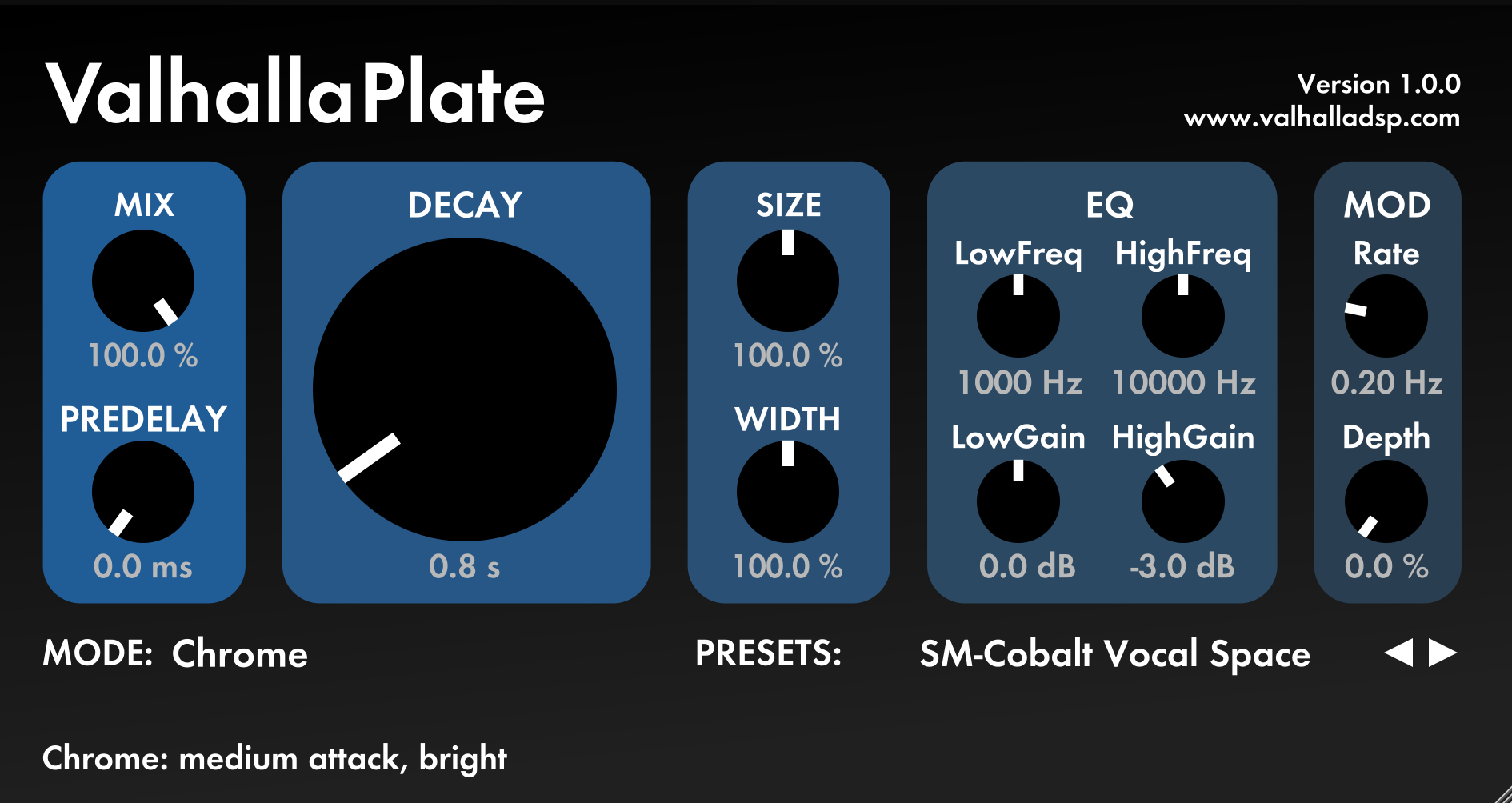
A quick rundown of the controls (GUI picture added for reference, and because I think it’s purty):

ValhallaPlate_V1_0_0

MIX: Yer standard wet/dry mix, with 0% corresponding to a dry signal, 100% corresponding to only reverb, and 50% being an equal mix between the two. The mix control uses the standard sine/cosine crossfade law that all my plugins use.

MIX lock: Click on the word “MIX” above the MIX knob, to lock the MIX at a given value. This is useful when browsing through presets, or when using ValhallaPlate as a send. It was designed to use as a send, by the way. Sends are AWESOME for reverbs.

PREDELAY: A stereo pre-delay, in front of the plate models. The time is specified in milliseconds, and the knob is warped so that there is more control over shorter delays.

DECAY: The ticking heart of the plugin. This controls the midrange decay time, which is defined differently for the different reverb modes. In general, this is an accurate measurement of the RT60 between 2.9 kHz and 3.6 kHz. Below this frequency, the decay time will be either shorter or longer. A quick rule of thumb:

  • For DECAY settings <1 second, the low frequency decay will be shorter than the display.
  • For DECAY settings between 1 and 2 seconds, the low frequency decay will roughly track the DECAY setting.
  • For DECAY settings > 2 seconds, the low frequency decay will be longer than the DECAY setting.
  • The specific decay/frequency curve is dependent on the MODE setting.

High frequencies tend to have a fairly short decay setting, regardless of the DECAY setting. Short settings of DECAY will have shorter high frequency decays, but once you get DECAY settings > 3 seconds, the high frequency decay time tends to stay fixed. Again, different modes will have different high frequency decay behavior.

The DECAY knob has been warped so that the majority of the knob travel covers “typical” plate decays, i.e. between 0.5 and 6 seconds or so. The last 25% of the knob travel allows for decay times much longer than a physical plate. This probably isn’t physically accurate, but whatever. It sounds cool.

SIZE: This controls the “size” of the plate, in arbitrary units. More accurately, this controls the modal density of the plate. Smaller sizes (between 0% and 100%) will create a more metallic sound, that is typical of physical plates. Larger sizes (> 100%) allow you to get a much higher modal density than a typical plate, which can create a “smoother” or “clearer” reverb sound.

WIDTH: Adjusts the stereo output width of the reverb. 100% corresponds to a typical reverb plate, where each pickup goes to a separate output channel. 0% mixes the left and right outputs together, and sends them to the left and right output channels. Quite frankly, I think this sounds kinda weird, but WIDTH settings <100% can be useful for creating a smaller stereo image. WIDTH settings >100% increase the perceived width of the image. This isn’t a conventional M/S matrix – the WIDTH control has been optimized for reverb signals.

EQ / Low Freq: Adjusts the cutoff frequency of a 1st order low shelving filter on the output of the reverb.

EQ / Low Gain: Adjusts the boost/cut of the frequencies below the EQ Low Freq setting. This is a gentle boost/cut, and can be used to add some clarity or weight to the reverb.

EQ / High Freq: Adjusts the cutoff frequency of a 1st order high shelving filter on the output of the reverb.

EQ / High Gain: Adjusts the boost/cut of the frequencies above the EQ High Freq setting. This is a gentle boost/cut, and can create some nice warmth when turned below 0 dB, or add a little sheen when turned above 0 dB.

It is worth noting that the equalization of ValhallaPlate will change with the DECAY setting. This is found in real physical plates. The overall equalization is different for each of the reverb modes, with different modes having more or less inherent brightness. Also, the EQ filters are not embedded within the reverb algorithm itself, so the settings of these filters will not affect the decay of the reverb.

MOD Rate: Controls the speed in Hertz of the low frequency modulation of the reverb. This is a chorusing-type modulation, but more subtle than I have used in previous reverb models. The goal of the modulation is to reduce metallic artifacts, without creating pitch changes or obvious chorusing in the output signal. I tend to like to set this between 0.2 Hz and 0.5 Hz, but values up to 2 Hz are useful in making big reverbs for synths.

MOD Depth: Controls the depth of the reverb modulation. For realistic physical plates, this should be set to 0%. Turning this up will take much of the “metal” out of the plate, which can be a good thing for more generic reverb applications.

MODE: This menu displays the active reverb modes, and can be used to select one of seven unique plate emulation algorithms. I will be explaining the various reverb modes in a separate post.

PRESET: This displays the name of the active preset. Click on the name of the active preset to bring up the reverb menu, which allows you to select different presets, save presets, import presets from text format (useful for pasting into forums, emails, blogs, etc.), and export presets.

The arrows to the right of the preset name allow you to scroll through the list of presets.


The Physics and Psychophysics of Plates

Plate reverberators were introduced in 1957 with the EMT140. This was touted as a compact alternative to a reverberation chamber. This is true, as long as you consider a 400 pound twin mattress-sized box to be “compact.” By 1957 standards, it was compact enough, as several plates could be put into a single room and controlled remotely.

The principle behind a plate is fairly simple, yet totally brilliant:

  • A 1 meter x 2 meter x 0.5 mm rectangular steel plate is suspended via tight springs in a steel frame.
  • The signal is injected into the steel plate via an “electro-dynamical actuator,” moving transversely to the plate (i.e. perpendicular to the plate).
  • One or more piezoelectronic pickups are attached to the plate at different locations. By using two pickups, a wide stereophonic image is obtained.
  • The reverb time is controlled by a felt damping plate, that is placed in parallel to the plate without contacting it. The closer the damping plate gets to the steel plate, the shorter the decay time is.

Plate reverberation has some strange characteristics, due to the unique physics of a plate. This has been described in detail by Jonathan Abel, Kevin Arcas, Stefan Bilbao, and other smart academic folk. A high level summary of some unique plate properties:

  • Dispersion. This means that the speed of sound is different for different frequencies, with high frequencies having a much faster speed of sound than lower frequencies. This results in an audible “PEW!” sound [read that as a laser gun sound] for the attack of the sound. At least in some plates. Other plates have a less audible “PEW!”
  • Instant onset of reverb. No fade in at all. Not even a subtle fade in. We are talking instant. There is no build up time.
  • Instant onset of high echo density. This is partly due to the fairly small size of the plate, and largely due to the high speed of sound at high frequencies versus low. The echos are distorted by this speed of sound, to the point where the high frequency echos will have a bunch of reflections by the time the low frequencies have their first reflection. To our ears, this sounds like a reverb that is instantly “fully mixed.”
  • Frequency dependent decay time. Surprisingly enough, a real EMT140 is fairly dark. At 10 kHz, the decay time on an EMT140 is <1 second, at any setting of the decay damper. Conversely, the very low frequencies can end up booming out. Stainless steel plates have a longer high frequency decay time, and a brighter sound overall.
  • Constant resonance density versus frequency. This is different than a real world 3D space. However, this is how most digital reverbs behave.
  • Not necessarily metallic sounding. You’d think that a reverb made out of a 3’x6′ piece of cold rolled steel would sound, well, like steel. However, a well tuned EMT140 is super smooth. There is a slight amount of metallic sheen for high frequencies, but the sound overall is less metallic than most digital reverbs.

So, a plate has dispersion, instant echo density, instant onset of reverb, frequency dependent reverb time. What are the implications of this for music production?

During the research for ValhallaPlate, I experimented with various models, where I could dial in the amount of dispersion over different frequencies. It turns out that the “PEW! PEW!” sound of dispersion isn’t all that important to the overall sound. Some plate impulse responses had a noticeable amount of PEW! artifact, but real word plates tend to have less of this sound. The algorithmic models that had more of a “PEW!” sound were kind of annoying.

I found was that dispersion, when properly tuned, has a huge impact on the stereo imaging of the reverb. My current theory on what is going on:

  • The pickups in an EMT140 are staggered off-center, and are at different distances from the input signal transducer.
  • For high frequencies, these distance differences translate into very slight time delay differences of the reverb onset between the left and right channels (i.e. less than 1 msec). The slight time delay causes the reverb to “lean” slightly to one side, due to the Haas effect. This is pretty subtle, both in physical plates and in a properly tuned algorithmic model.
  • As the frequencies get lower and lower, the time difference for the onset of reverberation between left and right channels gets wider and wider. For low frequencies, this difference can be in excess of 10 msec.

My theory is that this time difference in the left and right channels for low frequencies contributes to the depth of the stereo image. A plate reverb doesn’t just sound like it is wider than the speakers – the sound appears to come from behind the speakers. It is a big, 3D sonic image. The small time difference between left and right channels for high frequencies helps to keep the reverb from sounding “mushy” or overly diffuse. This is important for sharp transients, such as percussion.

The instant echo density and instant onset of reverberation in a plate makes it a reverb that can be used on pretty much any source. Different digital reverb algorithms are often described as being optimized for different source signals, i.e. “Percussion Plate,” “Vocal Chamber,” etc. This is due to the artifacts of different digital algorithms, and the tradeoffs between echo density and metallic sound. A physical plate reverb just sort of works on everything. Drums, vocals, strings, guitars, whatever.

The frequency dependent reverb time of a plate models what happens in a physical space. In a large space such as a hall, the low frequencies will have a considerably longer decay time than the mid range frequencies. High frequencies in a physical space will always be damped by the air, so that the maximum RT60 at 10 kHz will never exceed around 1.25 seconds for any physical space.  In this sense, a plate reverb effectively mimics the “real word.”

This frequency dependent decay time also makes it easy to mix with a plate reverb. The decay time parameter of a plate (which is either controlled via a remote, or by turning a huge wheel on the plate itself) is essentially the RT60 at some arbitrary midrange frequency, somewhere between 2 and 3.5 kHz. This midrange decay time is useful for dialing in the decay on those parts of the input that are audible as pitch. The high frequencies always have a fairly short decay, so consonants and sibilance won’t ring out for too long. The result is a reverb that has plenty of zingy brightness, but without the sibilance turning into annoying hiss, which can easily happen with digital reverbs.

Later plate reverbs, such as the Ecoplate developed in the 1970s, used stainless steel, versus the cold-rolled steel used on the EMT140. The goal was to get a longer decay time for higher frequencies. This seems in keeping with the general trend of the 1970s towards brighter sounds, which can be attributed to higher spec recording gear, the arrival of early digital units, and cocaine abuse [note from editor: you might want to clean this up before hitting PUBLISH]. Today, the darker sound of the EMT140 is still highly sought after. The short decay time of high frequencies means that an EMT140 can be inserted into a mix without being obtrusive. It just works.

The characteristics of reverb chambers versus plates

Plate reverbs have some distinctive characteristics:

  • Instant onset of reverberation
  • Instantly high echo density
  • Bass RT60 (reverberation decay time) that is considerably longer than the midrange
  • Fairly short RT60 for the treble frequencies, no matter what the reverb decay setting is at

Interestingly enough, these characteristics are shared by reverberation chambers!

  • A typical reverberation chamber is made out of brick, stone, concrete, or some other dense material (such as several layers of drywall).
    • The walls are usually covered with several coats of plaster. This provides a highly reflective surface, which allows for the midrange to decay for several seconds.
    • Studies from the late 1960s showed that the reverb time of a chamber would increase after a few years. This was attributed to the plaster becoming less absorbent as it dried out.
  • The size of a reverberation chamber is usually fairly small, on the order of 1000 to 2000 cubic meters. This will result in a rapid onset of reverberation, as well as high echo density, since the sound just doesn’t have that far to go before it reflects off of other surfaces.
    • There is a slight delay in the onset of reverberation, compared to a plate. This is probably due to the usual microphone/speaker configuration, where the speaker is aimed towards the nearest wall, and the microphone is aimed towards the opposite wall (the idea being to minimize how much of the direct signal from the speaker is captured by the microphone).
  • The bass RT60 of a reverb chamber is dependent on the material used for the walls.
    • Concrete reverb chambers often had a very long bass RT60, compared to the midrange.
    • This would have been dealt with by EQ on the reverb send/return. At Abbey Road, for example, the reverb sends went through a bandpass filter, that cut out virtually all energy above 10 kHz and below 600 Hz.

There are a few significant differences between plates and reverb chambers.

  • The dispersion in a plate will result in different stereo imaging than in a reverb chamber.
    • In a plate reverb, the speed of sound at low frequencies is much slower than at high frequencies. This results in a significant time difference (~10 msec) in the onset of reverberation between the left and right channels for very low frequencies, transitioning to a fairly small time difference (~0.5 msec) for high frequencies between the left and right channels.
    • A reverb chamber is full of air, which isn’t a dispersive medium. The time delay between the channels will be based on the time delay between the output of the speaker and the first reflection received by each microphone. There will be all sorts of phase complexity after a period of time (given how signals mix), but you won’t have the phase weirdness you find in a dispersive plate.
  • A reverb chamber will have a higher modal density than a plate.
    • The term “modal density” refers to the number of resonant modes (or resonances, or eigenmodes) that can be heard in the sound of a resonant object or space.
    • A reverb can be viewed as a whole bunch of parallel resonators. Each of these resonators is like a little bell, that rings out when excited by the input being close enough to it in frequency.
    • The more resonances here are, the smoother the reverb produced (as long as they are spaced together kinda randomly, but not too randomly).
    • The larger the physical space, the more resonances there will be in the reverb.
  • The resonance density of a chamber will increase with the square of frequency.
    • This is the case for all 3D physical spaces.
    • Plate reverbs have a roughly uniform resonance density with regards to frequency.
    • Artificial reverbs based on delay lines usually have a roughly uniform resonance density with regards to frequency. This makes a plate model a reasonable goal for a digital reverb.

In an upcoming post, I will talk about how ValhallaPlate has been designed to not only emulate plate reverbs, but also some of the key characteristics of reverb chambers.


Introducing Valhalla Plate

I am happy to announce the latest plugin in the ValhallaDSP lineup, ValhallaPlate.

ValhallaPlate_V1_0_0

Plate reverbs have been an obsession of mine for a long time. As a reverb developer, the physics of plates are fascinating. The physical structure of a plate reverb is pretty basic, if a little strange: a thin sheet of steel is suspended by springs in a metal frame, the input signal is imparted to the plate via a transducer, and the output is taken from pickups directly attached to the plate. The behavior of plate reverberators is complex and wonderful:

  • Instant onset to the reverberation
  • Instant high echo density
  • Dispersion (the speed of sound is different in a plate for different frequencies, with high frequencies moving faster than low frequencies)
  • A complex frequency/decay curve, where the low frequencies can have a MUCH longer or shorter decay than the midrange frequencies, and the high frequencies always have a fairly short decay

More importantly, I love the sound of plates. Plate reverbs are often associated with the 1960s, but they were heavily used in the 1970s and 80s, and continue to be used to this day. Contrary to popular belief, a well-tuned plate reverb doesn’t sound metallic, and isn’t particularly bright. The reverberation frequency/decay curve tends to work on almost any source material, from guitars to vocals to drums to, well, almost anything.

A few years ago, I became obsessed with the vocal sound of the first few Fleet Foxes records. It turns out that these records used an EMT140 plate at Avast Recording Company, located here in north Seattle. The vocal reverb on these Fleet Foxes recordings is evocative of many 1960s recordings, but with the levels and decay time cranked way up:

During the past few years, I have kept plate reverbs on a mental back burner. I’ve read any papers I can find on the subject, sought out recorded examples of plates, and filed away any plate-ish artifacts in my algorithmic experiments in a folder to revisit at a later time. Once the big website redesign was done in late 2014, I was able to start working on plate reverberator prototypes in earnest. Heading into Avast Recording with Don Gunn, and spending the day working with the EMT140 that I had been listening to on records, was one of the most exciting days of my career.

After years of R&D, and close to a year of dedicated programming work, ValhallaPlate is finally available to the public. Over the next few weeks, I will be publishing several blog posts, where I describe the history of plate reverbs, the physics and psychophysics of plates, and how I applied the research results to the design of ValhallaPlate. For now, you can head on over to the ValhallaPlate page, download the demos, and hear the results for yourself.


Slides from my AES Reverb presentation

I was invited by the Seattle chapter of the Audio Engineering Society to speak about reverbs and reverb design. I threw together some slides:

AES2015ReverbPresentation

Pretty skeletal deck, but it was (hopefully) more entertaining when presented in person. Don Gunn helped me out with a Logic X project that accompanied the presentation. Don also listened to me when I practiced the presentation, and was graceful enough to pretend that he hasn’t heard me ranting on the same topics about 100 times before.

I think I learned more from the people in the audience at the AES presentation than anyone learned from me! It was cool to hear anecdotes from people that had worked at Lexicon and Alesis, as well as folks that had a lot of experience with plate reverbs and echo chambers. Thanks to Christopher Deckard for inviting me to speak, and thanks to everyone that attended the presentation.

Naming reverb algorithms

I’ve created a lot of reverb algorithms at this point in time. I’ve released several dozen in plugin form, and have written hundreds more. It turns out that it is a little tricky to come up with names for all these algorithms.

During the development stage, I tend to name the algorithms after the internal structure. Things like “BigFDN32,” or “AllpassLoop8.” However, these names don’t mean anything to people that don’t design reverbs. Plus, the same structure can sound markedly different, depending on the delay lengths, how the coefficients are set, the filtering used, and so on.

The easiest names are to adopt the names of physical structures, that people are familiar with. Hall, Room, Chamber, Plate, that sort of thing. However, when you are creating algorithmic reverbs, the name has very little to do with the corresponding physical structure. A real hall will have a few orders of magnitude more modal density than can reasonably be achieved with an algorithmic reverb. Even a small room would tax modern CPUs, if modeled accurately. A physical plate has all sorts of weird characteristics that aren’t usually captured in the digital models.

Several years ago, I asked Keith Barr about naming conventions for digital reverbs, and whether there was any “standard” for how reverb algorithms were named. The whole thread at the Spin Semiconductor forum is worth reading, so here’s a few choice quotes from Keith (R.I.P.):

To the best of my knowledge, with the exception of some possible inside jokes that I have not been privy to, reverbs are named according to their sound. -Since the digital methods that approximate the acoustics of physical structures are recent compared to the acoustical impressions spaces have given over the course of human history, and since most folks don’t think in terms of reverb algorithms, we don’t call a plate a “spacially uncorrelated, extreme reflection density reverberator with distinct ringing and a multiorder high frequency loss”… We call it a plate.

Personally, I think the tendancy to name algorithms after physical structures is unfortunate, because we have the ability to make much nicer acoustic environments with digital hardware than most real world structures allow, with the possible exception of a parking garage I ran into once…

Keith goes on to give a good overview of how he named reverb algorithms:

Plate: Immediate build of diffusion, uncorrelated outputs, strong high/mid response (which rings), rapid rolloff of high frequencies, poor bass response.

Room: Fast build, short (~10mS) and multiple initial reflections, ringy in the mid frequencies, high frequencies depend on wall treatment, bass variable.

Hall: Long delays in the initial sound (30~120mS), slow build, poor high end response, moderate diffusion build, moderate bass respopnse.

Digital: (this should be a popular option) Beautifully dense, no ringing, extended response with sparkling highs, deep bass response (when wanted), cascading showers of even tonality.

The first algorithms I developed for ValhallaRoom were named after rooms and chambers. Later on, I got bored, and started developing algorithms that didn’t particularly sound like physical spaces. These new algorithms had lusher modulation, and a much slower attack. At the time I was developing these, the movie Prometheus was in production, which prompted me to revisit the Alien movies. I named several of the algorithms after spaceships and places in the first 2 alien movies (Narcissus, Nostromo, Sulaco, LV-426). I am adding a new algorithm to the upcoming ValhallaRoom update, but actually seeing Prometheus put an end to that naming scheme; Red Letter Media summarizes my thoughts on this subject. The new algorithm is called Dense Room, which is boring, but is an accurate description of the sound.

For my upcoming Z-DSP reverb cartridge, Halls of Valhalla (not to be confused with this very blog, even though the name is eminently confusable), I included some of the standard reverb names: Room, Chamber, Plate, Cathedral. I had a few algorithms left over, that sounded bigger than the Cathedral. Where do you go from there? Stadium? Cistern? Taj Mahal? OK, now that I type those names, I realize they might have worked well, but it is TOO LATE NOW. Instead, I went with some names from Norse mythology, in keeping with the whole Valhalla theme.

Niflheim, Asgard, and Ginnungagap are cool words for reverb algorithms, and help convey a sense of huge space, without being tied into any particular construct in the real world. However, a quick viewing of my demo video for Halls of Valhalla will me it instantly clear that I have no idea whatsoever how to pronounce these words.*

One of the great features of digital reverberators is that they can create sonic characteristics that are highly exaggerated versions of what could occur in the real world, or depart wildly from what the real world can achieve. A large cathedral can have an attack time of up to 1/2 second, but ValhallaShimmer and other digital reverbs can easily fade in over several seconds. Alesis used the term “Bloom” for such slow attack reverbs, as I discussed in an older blog post. The recent Big Sky pedal from Strymon uses Bloom as an algorithm name for a similar effect. For that matter, the term “Shimmer” has been commonly used for reverb algorithms in the last few years that contain pitch shifted feedback, versus some of the older terms like “Octaverb.” It will be interesting to see what terms are developed over time to describe other digital effects that have no “real world” counterparts.

* For that matter, I’m pretty sure that ÜberMod isn’t pronounced OOOO-berMod. But THAT’S HOW I ROLL.

A new reverb cartridge for the Z-DSP: Halls of Valhalla

I have been working on code for the Tiptop Audio Z-DSP Eurorack processor for a few years now. I am pleased to finally announce my first product for the Z-DSP, a reverb cartridge called Halls of Valhalla.

The Halls of Valhalla cartridge features 8 original reverberation algorithms, designed to work with the strengths of the Z-DSP, and tailored towards electronic music.

The reverbs in the Halls of Valhalla are arranged in order of perceived size, from small to big to huge to uncomfortably enormous:

  • Room
  • Chamber
  • Plate
  • EnsembleVerb
  • Cathedral
  • Nilfheim
  • Asgard
  • Ginnungagap

Here’s a few sound examples. The first one is a simple 1-osc sawtooth sound, being sent into the EnsembleVerb algorithm. I am adjusting the Mix on the Z-DSP, and the Decay and Chorus parameters on the Halls of Valhalla program:

The next example is guitar, being fed through a B:assmaster fuzz, straight into the Z-DSP, running the Ginnungagap algorithm. The mix is set to 100% wet, and the decay is turned up somewhat.

Halls of Valhalla will be available Q1 2014. Pricing and distribution TBA.

And, yes, I know that the product name is the same name as this blog. IT’S A GOOD NAME.

Valhalla Vintage Verb is here

My, how the time flies! We’ve been keeping busy here at Valhalla DSP HQ.

The big news was the release in December 2012 of the latest plugin, ValhallaVintageVerb:

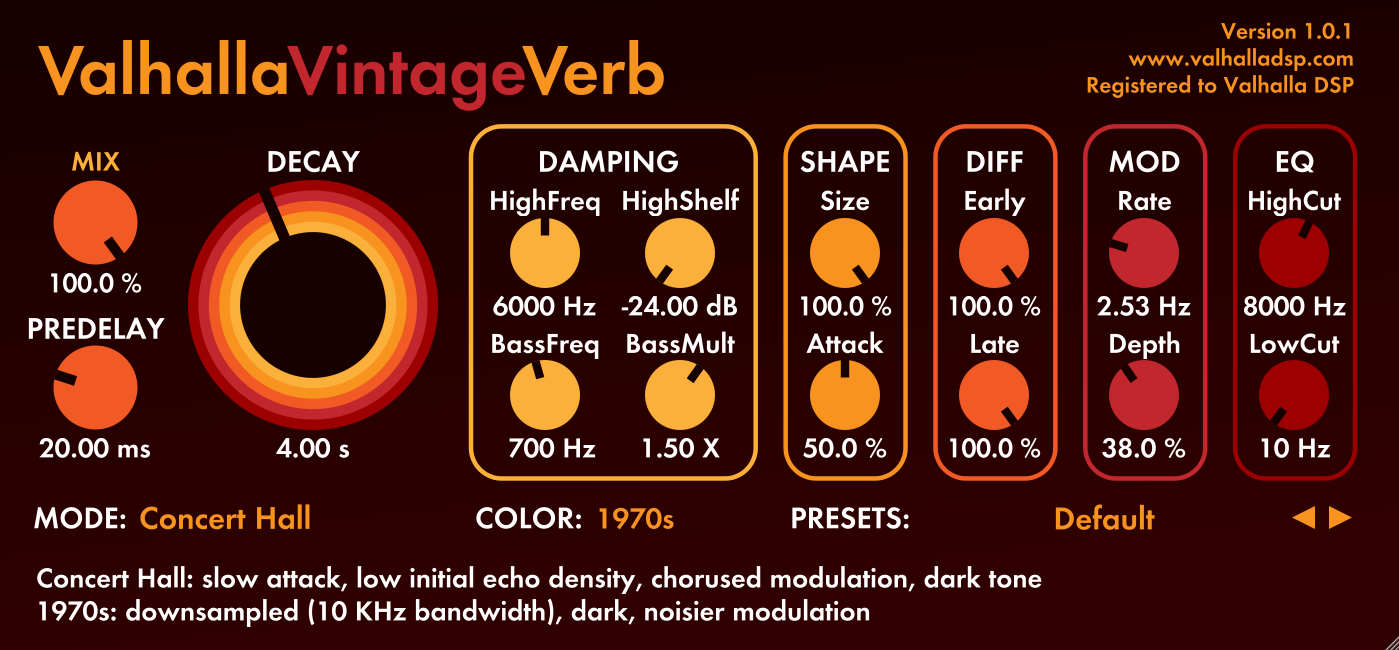
ValhallaVintageVerb1970s ValhallaVintageVerb is a collection of 9 reverb algorithms, inspired by vintage hardware reverbs such as the Lexicon 224/PCM70/300/480L, as well as the EMT250. The GUI continues the “superflat” aesthetic of the earlier Valhalla plugins, with Kristin adding lots of beautiful color and graphic design flourishes to the mix. The parameters have been carefully chosen to balance flexibility with ease of use.

ValhallaVintageVerb has received a great reception so far! Here’s a few reviews:

http://www.musicradar.com/reviews/tech/valhalladsp-vintageverb-574692

http://voxcaliber.com/review-valhalla-dsp-vintage-verb/

In other news, I am currently working on the AAX ports of the Valhalla DSP plugins [EDITORIAL NOTE: this is an old blog post, and the AAX ports have been done for a few years now]. The main tasks involved are updating my code to use the latest Juce code, and signing the AAX plugins with the Pace Eden copy protection. The progress is a bit slow right now, due to some issues Pace is having with their new copy protection system, so I am waiting for their issues to get resolved to get back on the ports. I’ll be sending out updated versions of the plugins to all users as the AAX ports are finished, as the VST/AudioUnit/RTAS builds will be updated at that time.