The Best Reverb Plugins For …

One of our most frequently asked questions: Which Valhalla reverb plugin is best for vocals/drums/guitars/etc?

We believe in subjectivity, so our most accurate answer is “whichever reverb sounds best to YOU!” Also, most of our reverb plugins cover a lot of ground, so you really can’t go wrong. VintageVerb, for example, is equally adept at short vocal reverbs and huge ambient washes.

However, as you might imagine, we do have strong preferences. I’ve logged countless hours in the reverb mines, and Don Gunn mixes with Valhalla reverbs daily, and has many good suggestions for best reverb uses. And, since all of these recommendations come from our heavily opinionated minds, we also asked YOU, the public, via Twitter which Valhalla reverbs you prefer for different styles and applications.

So, without further ado, here’s Valhalla’s Guide to The Best Reverb Plugin For _____ suggestions!

Best Reverb Plugin for Ambient Music

We created ValhallaShimmer with ambient music in mind. The pitch shifting in the feedback loop and the lush cascaded diffusors create huge ambient washes from any audio source. For a truly symphonic sound with evolving clusters of pitches, try cascading several instances of Shimmer in series.

The Hall algorithms in VintageVerb are also perfect for replicating that late 70s and 80s ambient sound. Turn up the diffusion in ValhallaDelay, and you have some glorious washes that rival what ValhallaShimmer can do. Plus, you can use the Pitch and Reverse Pitch modes for feedforward pitch-shifted reverbs. This allows for more precision over your ambient sounds.

ValhallaSupermassive also has many unique reverb algorithms that are ideal for ambient. And it’s FREE!

Twitter says:
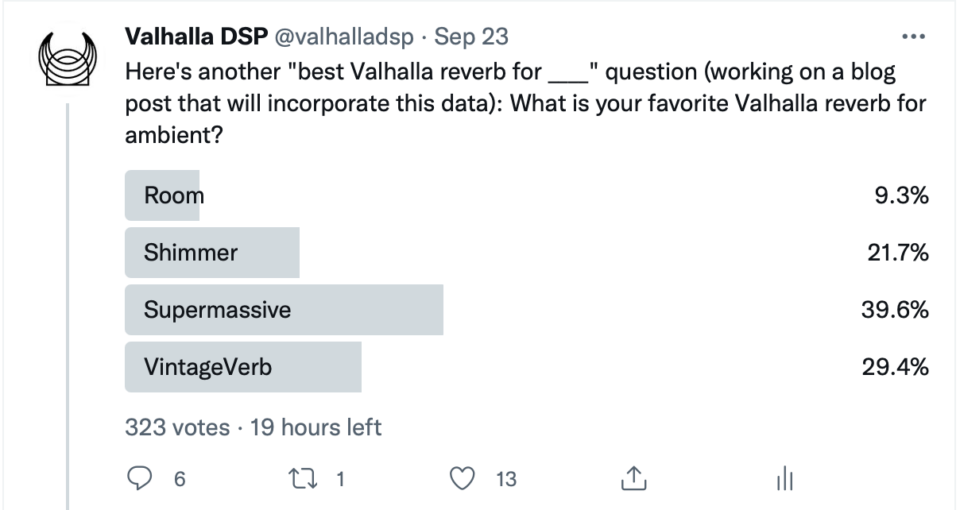
Best Reverb Plugin for Ambient per Twitter

Best Reverb Plugin for Classical Music

ValhallaRoom is the most popular Valhalla reverb for classical applications and virtual orchestral instruments. The Depth slider in Room is useful for setting up an early reflection / late reverb balance. The 12 unique algorithms in Room allow the user to put instruments into a realistic acoustic space.

VintageVerb is a great “jack of all trades” reverb, and the various Smooth algorithms are perfect for realistic acoustic spaces.

Here’s what y’all said on Twitter:

Twitter results for Classical Music

Best Reverb Plugin for Drums

Don prefers the Ambience, Dirty Plate, Dirty Hall, and Chaotic Chamber algorithms in VintageVerb for his drum mixes. He says, “I use Ambience when I want the impression of the space without hearing the space. I use Dirty Plate and Dirty Hall for bigger, splashier sounds, to make snare hits sound explosive, and for accents. I like Chaotic Chamber for smooth chamber sounds, and that chaotic modulation gets my motor running.”

ValhallaPlate is also useful for super smooth and dense drum reverbs. And the Depth slider in ValhallaRoom can be used to emphasize early reflections, which is great for emphasizing the attack of drums without hearing a ton of late reverb tail.

The Twitter results were surprising to me!
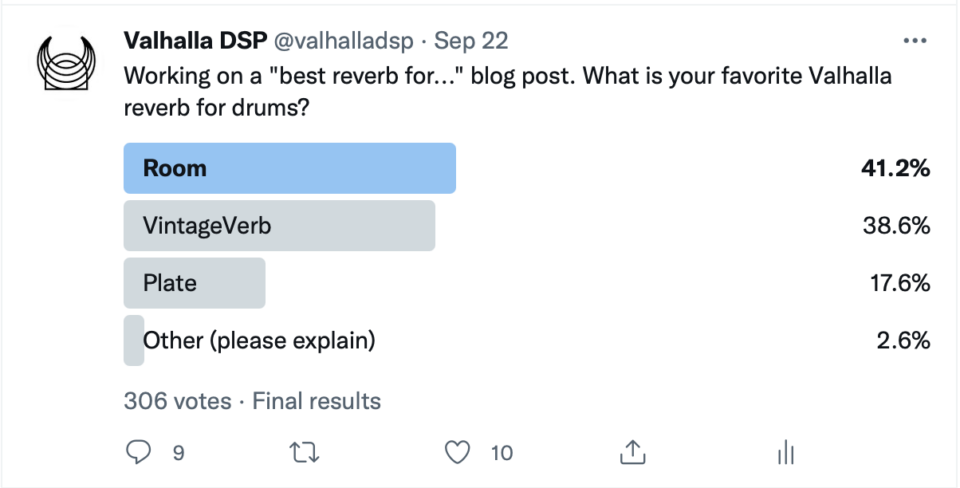
Top plugin to use on Drums per Twitter

Best Free Reverb Plugin

ValhallaSupermassive. No contest. With 16 unique reverb/delay algorithms, Supermassive holds its own with any reverb plugin on the market – and it’s FREE! FREE! FREE, I TELLS YA, FREEEEEEEEEE!!!

Best Reverb Plugin for Gated / Nonlinear / Reverse

VintageVerb has a fantastic Nonlin algorithm. It gives you short gated reverbs with realistic room decays, long reversed reverbs, and everything in between.

ValhallaÜberMod can get some great nonlinear reverbs using the 16 or 32-tap modes. The Tap Slope parameter allows you to dial in whether they fade in, fade out, or stay flat through their duration. The Sync parameter lets you sync the nonlinear time to your tempo.

Best Reverb Plugin for Sounding Expensive

OK, this is a nebulous category. When people talk about “sounding expensive,” it usually means sounding like something with expensive gear, but also smoother than vintage gear from the 80s. The Smooth algorithms in VintageVerb are the perfect solution. Inspired by vintage digital algorithms, I added a tapered decay for a smooth, natural exponential response.

Best Reverb Plugin for Synths

All of them, if I’m being honest! As part of my development process, I tune all the Valhalla plugins playing one or more analog synths as a live interactive sound source, along with the standard recordings of drums / vocals / piano / etc. But, for our purposes here, I’m gonna pick one: VintageVerb. Start with the Homestar Bladerunner preset, and work from there. That 3-4 sec decay in Concert Hall and Dirty Hall makes all the synths in the mix sound huge.

During the coding process, I dialed ValhallaDelay in with the Moog Grandmother. Turn up the Diffusion, and you have some great synth reverbs. I also used the Grandmother and Prophet-6 as sound sources when designing Supermassive.

The Twitter poll results skewed heavily towards VintageVerb, although in retrospect I should have added Delay and Supermassive as polling options.

Best Synth reverb per Twitter

Best Reverb Plugin for 60s / 70s Vintage Sounds

I designed ValhallaPlate to replicate the classic analog steel plate reverbs found in studios during the 1960s and 1970s. It’s perfect for “vintage” sounding reverb for acoustic guitar, vocals, drums, and what have you.

Best Reverb Plugin For Vintage Digital Sounds

To dial VintageVerb in, I referenced various high-end 80s digital hardware reverberators. I tuned Dirty Hall and Dirty Plate modes using a classic 1984 reverberator. I also paid special attention to the quantization noise, the “modem” noise from the delay modulation, and the lush and long decays found in that unit.

Best Reverb Plugin for Vocals

The Early and Late Diffusion controls in VintageVerb make it easy to get a smooth vocal reverb without sounding metallic. My recommendation is to adjust the Diffusion until the time response on sibilance is smooth (i.e. without obvious echo patterns), and then bring the Diffusion down just a touch to reduce coloration.

The good folks that follow Valhalla on Twitter seem to agree that VintageVerb is great on vocals:

Top Valhalla reverb for Vocals per Twitter

Best Reverb Plugin for Weird / Experimental

From the ground up, I designed ValhallaÜberMod for weird and experimental reverbs. It’s full of delays, echoes, modulation effects, and all sorts of sounds that defy categorization. The Diffusion section can serve as a reverb in its own right. You can also toss in up to 32 modulated delay taps for results ranging from super flanged reverbs to jittery pitch glitching orchestral sounds to lush ensemble washes. Even after all these years, this plugin continually surprises me.

ValhallaDelay also has all sorts of aggressive and strange sounds on tap. Turn up the Diffusion, and any delay mode can turn into a lush reverb with weird characteristics. With analog-esque saturation, multitap feedback, and the unique Ratio mode, Delay is perfect for sound design and sounds that leap out of the mix.

And, of course, ValhallaSupermassive holds its own in the weird reverb race, and is FREE!

The results of the Twitter poll skewed pretty heavily towards Supermassive:

Top Valhalla choice for Weird and Experimental reverb per Twitter

As always, this kind of thing is subjective, so we’d love to hear your thoughts. Did we nail it? Miss something? Let us know in the comments below!

Two New Valhalla Supermassive Reverb Modes For 2022!

ValhallaSupermassive is 2 years old, and to mark the occasion, we’re releasing the 2.0.0 Supermassive update with two new reverb modes, Aquarius and Pisces.

Aquarius and Pisces are both modified feedback delay networks in a topology I’m calling “EchoVerb.” These algorithms have a strong audible echo, which directly corresponds to the displayed Delay time. By modifying WARP, FEEDBACK, and DENSITY, Aquarius and Pisces can be used for standard delays, delays with reverb mixed in, reverb with a strong pre-delay, or weird and wild echo sounds.

Valhalla Supermassive Reverb Mode: Aquarius

Aquarius New Reverb Mode for Valhalla Supermassive

The Aquarius mode is similar to the earlier Capricorn mode, in that it has 8 delays in the feedback delay network. The main change is that Aquarius only has two delays in the output signal: one for the left channel, one for the right channel. The left and right output delay lengths are the same, regardless of the WARP setting. This results in a very audible echo/delay in the signal, especially with low settings of DENSITY. As the DENSITY control is turned up, the other delays in the feedback delay network have more of their outputs sent into the global feedback path, which results in a more reverberant sound – or in more comb filtering with low settings of WARP. When WARP is at 0% and the modulation DEPTH is at 0%, turning up DENSITY will result in weird cancellations in the echo signal, that can create interesting polyrhythms and panning.

Valhalla Supermassive Reverb Mode: Pisces

Pisces New Reverb Mode for Valhalla Supermassive

The Pisces mode is essentially a denser version of the Aquarius mode, and can be viewed as a modified Gemini mode with only two output delays (one for the left channel, one for the right). As the DENSITY control is turned up, the outputs of the other delays in the feedback delay network are mixed into the global feedback path. Since there are more delays in the Pisces mode, the reverb will build up density and lushness more quickly than the Aquarius mode.

A Few Tips and Tricks For the New Modes

I feel like these two new reverb modes, Aquarius and Pisces, are the most generically useful modes in Supermassive. Weird sounds are definitely on tap, but these modes specialize in reverberant echoes – i.e. echoes with some reverb mixed in there. Switch the delay time to tempo sync, and the new modes are perfect for adding rhythmic delays to your music, with as much or as little reverb as you want. The DENSITY control allows you to adjust how long it takes to turn the echoes into reverb, which is perfect for keeping your sounds defined in your mix!

  • Aquarius Echo/Reverb: set WARP to 60% or higher, DENSITY between 40% and 70%, and FEEDBACK for the desired amount of echo feedback. The higher the Density setting, the quicker the sound will transform from an echo to a reverb.
  • Pisces Echo/Reverb: set WARP to 60% or higher, DENSITY between 30% and 60%, and FEEDBACK for the desired amount of echo feedback. The Pisces mode has a higher inherent echo density than the Aquarius mode, hence the lower DENSITY values.
  • Aquarius/Pisces Reverb w/ pre-delay: Set WARP to 60% or higher, DENSITY to 100%, and FEEDBACK to the desired reverb length.
  • Panning/tremolo echoes: Set WARP to 0%, FEEDBACK to the desired echo repeat duration, MOD DEPTH to 0%, and use DENSITY to vary the panning/tremolo rate.
  • The 2.0.0 Supermassive update installs a new preset folder, SPRING 2022. These presets showcase the above tips and tricks for the new modes and should serve as a useful place for future experimentation.

Sound Examples

In this piece, I’m using the Aquarius mode to add a 1/4 note echoVerb to an ARP 2600M line, with Pisces used for a dotted 8th delay during the second half of the piece (Triangulum is used for looping):

Here’s an example of the weirder side of the Aquarius and Pisces modes, adding rhythmic panning echos to the MS20 melody and ARP 2600 percussion:

How To Get ValhallaSupermassive Aquarius and Pisces

As always, ValhallaSupermassive is a FREE plugin, available for both Windows and Intel/ARM Macs. Just head on over to the Supermassive page, or go over to our new Demos & Downloads page and grab all of our free plugins, as well as demos for the commercial ones.

We hope you enjoy the ValhallaSupermassive 2.0.0 update and thanks for your support!

Valhalla VintageVerb Updated to 2.2.0: Cathedral Mode!

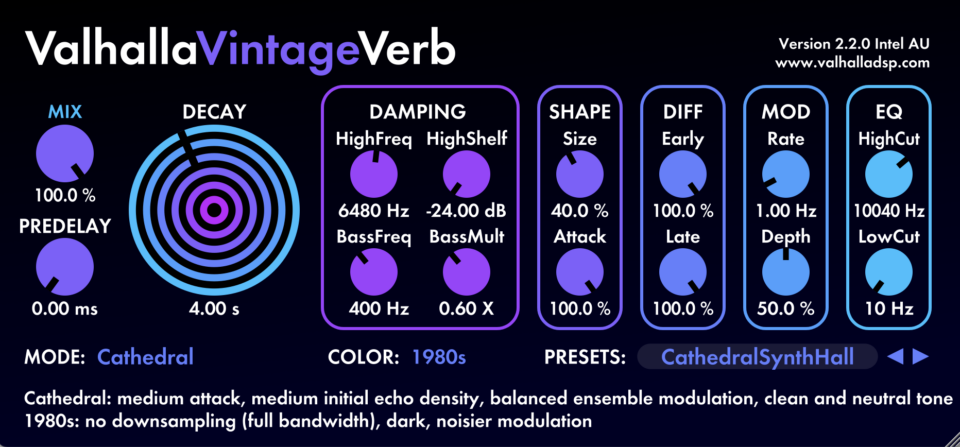
We are happy to announce the release of the Valhalla VintageVerb™ 2.2.0 update. The biggest update to VintageVerb? The new reverb mode, Cathedral!

Valhalla Vintage Verb: Cathedral Mode

Valhalla Vintage Verb Cathedral Mode GUI

Inspired by the FV-1

The Cathedral mode is based on an algorithm I developed for the Spin Semiconductor FV-1 in 2014. The FV-1 is a fun little DSP, but it is severely limited in delay memory, and is optimized to work with specific reverb architectures. Cathedral was my favorite algorithm I developed for that chip, with a big diffuse sound and ensemble style modulation.

Bringing Cathedral into VintageVerb meant I could use a lot more delay memory, for a bigger more expansive attack and decay, as well as a more open and transparent sound. The original FV-1 algorithm corresponds to a Size setting of 50%, while sizes greater than 50% will get closer to a real-world cathedral. The VintageVerb version of Cathedral also has a much more comprehensive Damping section, which allows for high frequencies to smoothly decay away as found in large acoustic spaces. We’ve retained the ensemble modulation, with the Rate and Depth controls allowing the user to dial in the perfect amount of lush chorusing.

Best for Huge Synth Verbs, Vocals and Acoustic Instruments

The Cathedral algorithm is perfect for huge synth verbs, but is also well suited for vocals and acoustic instruments. Set the Size to a lower value, and Cathedral can create some convincing drum rooms. In this example, I’m using Cathedral on synth for a big reverb, as well as a shorter drum reverb:

We’ve also modified the information text in the upper right corner of the plugin, so that the user can tell at a glance the version number, the type of plugin running in the DAW (VST/VST3/AAX/AU), and Intel versus ARM when running on a Mac.

Cathedral Mode is FREE for Vintage Verb Owners!

If you already own VintageVerb, the update is in your user account, so log in and grab the latest installer. If you don’t own VintageVerb, feel free to grab the demo from our new Demo and Downloads page, and check out Cathedral and the other 18 reverb algorithms that are unique to VintageVerb. We hope you enjoy the VintageVerb update, and thanks for your support!

ValhallaSupermassive 1.5.0 Update. Two New Reverb Modes!

We have just released the 1.5.0 update to our FREE reverb/delay plugin, ValhallaSupermassive:

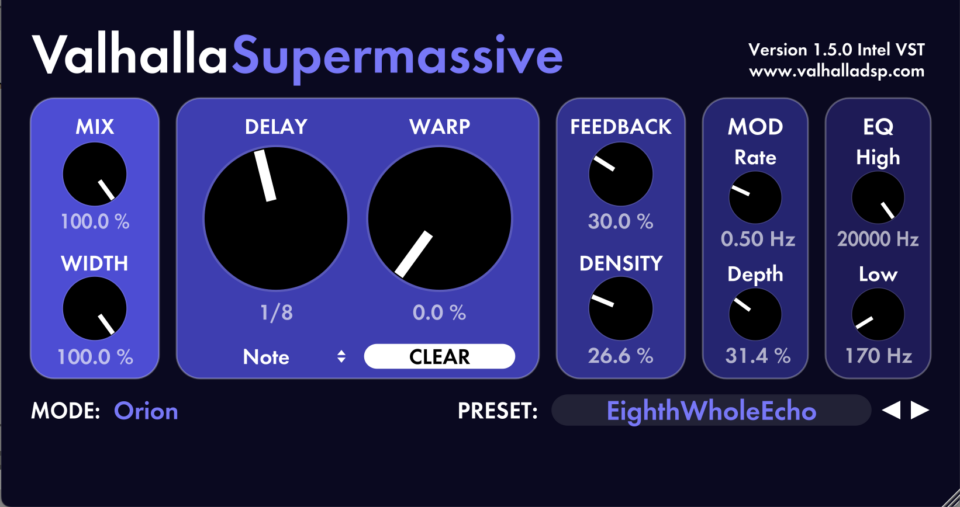
The 1.5.0 update to Supermassive adds two new reverb modes, Orion and Cassiopeia. These are WEIRD reverb algorithms, based on some advanced extensions of Michael Gerzon’s feedback delay network theory. Both Orion and Cassiopeia can sound quite sparse at the beginning of their decay, but can quickly build in echo density with non-zero settings of the Density control. The Density control also has a lot of influence on the reverb decay, with high density settings resulting in very long decays regardless of the Feedback setting.

Cassiopeia is the “smaller” of the two algorithms. In general, you will get shorter decays and echo patterns when using Cassiopeia, compared to Orion. One of my favorite settings is to set Warp to 0%, and use Density and Feedback to get echos that have a noticeable pulse on every 4th repeat. In this piece, I’m using 2 instances of Cassiopeia, once for a reverb that starts sparse and gets denser, and another for the pulsing repetitive echo:

Orion is “twice as big” as Cassiopeia under the hood, but this results in much longer reverbs and echoes than Orion, due to some laws of reverb physics that are a mystery even to me. Set Orion to the same settings as listed above for Cassiopeia, and you can get a mysterious echo that has a noticeable pulse on every 8th repeat. Turn up the Warp and Density values, and you will get truly massive modulated reverbs that can last for upwards of several minutes. Here’s an example of a single Orion instance used to get a long modulated looping echo:

Orion and Cassiopeia are definitely not conventional reverbs. These are weird, tricky reverb & delay algorithms, and we’re offering them to you in the spirit of exploration! In order to help guide you on your curiosity voyage, we’ve created a number of presets under the LATE 2021 preset folder that showcase some of the applications of Cassiopeia and Orion.

We’ve also expanded the “info” section in the upper right corner of the Supermassive GUI. This allows you to tell at a glance what version number you are running, the plugin format (VST/VST3/AAX/AU), and whether you are running it on an Intel or ARM Mac (the Windows version just assumes Intel/AMD).

As always, ValhallaSupermassive is a FREE plugin, available for both Windows and Intel/ARM Macs. Just head on over to the Supermassive page, or go over to our new Demos & Downloads page and grab all of our free plugins, as well as demos for the commercial ones. We hope you enjoy the ValhallaSupermassive updates, and thanks for your support!

Getting Started With Reverb Design, Part 4: The Best Books

My obsessive interest in audio DSP started in the late 1980s. Back then, “the Internet” was something that I had barely heard of and had never used. If I wanted to learn about something, I read about it in a book, or went to a library and looked up the information in a journal. During the late 90s, my backpack was stuffed full of heavy computer music and DSP books, that I would obsessively pore over, trying to force my brain to comprehend the strange symbols and equations contained therein.

Nowadays, the web is full of amazing resources for learning audio DSP, and you don’t have to go to a library to read an article in a bound journal or microfiche. I still love books, though, and have held on to the best ones I’ve found over the years, while still seeking out new ones as they become available.

Best Books for Reverb Design

As far as recommending books for people getting started in reverb design, I’m steering clear of compilation volumes like “Foundations of Computer Music” and “The Music Machine.” These were invaluable to me in the 90s and 2000s, but nowadays you can find these papers online. I’m also staying away from generic DSP textbooks and sticking with books that are highly focused on musical and audio DSP with applications to reverb design. So this is a shortlist, compared to what I own, but I feel it’s a good starting point.

Sean Costello's library of reverb plugin design books

The Technology Of Computer Music, by Max Mathews (The MIT Press, 1969)

This list needs to start at the beginning: Max Mathews, the pioneer of using computers to create music. This book is mainly an overview of the Music V language, but also serves as an introduction to the idea of unit generators for processing audio. The explanation of how Music V generated low-frequency noise is one I still turn to today.

Musical Applications of Microprocessors, 2nd edition, by Hal Chamberlin

The Chamberlin book is probably most famous nowadays for the “Chamberlin filter,” an early digital realization of the state variable filter, which was used in lots of early digital synths and plugins. Chamberlin goes into reverb design, but the algorithms tend to be fairly simple extensions of Schroeder’s work. What makes Musical Applications of Microprocessors invaluable today is the discussions about how digital hardware and software worked in the early days when computers were rare and digital audio interfaces were even rarer. Chamberlin’s discussions of “floating point converters,” for example, were very useful to me when I was working on some updates for VintageVerb back in 2013, to dial in the particular artifacts I was hearing in early 80s digital hardware.

Computer Music, by Charles Doge and Thomas A. Jerse (Schirmer Books, 1st edition 1985, 2nd edition 1997)

Dodge & Jerse is a classic introductory textbook to the principles of computer music. The 2nd edition was required for my computer music classes at the University of Washington in 1998-9, and I read that book from cover to cover. I had bought the 1st edition back in 1988, but it wasn’t until the late 90s that I understood what was going on. This book has a great introduction to digital delay lines, as well as “old school” digital reverberation (I talk more about Schroeder/Moorer algorithms here). I still have to go to the 2nd edition to find the equation for calculating the feedback gain for a comb filter to get a particular RT60. I’d recommend BOTH editions – the 2nd one is more up-to-date, but the 1st one has useful FORTRAN code for all sorts of unit generators.

Applications of Digital Signal Processing to Audio and Acoustics, edited by Mark Kahrs and Karlheinz Brandenberg (Kluwer Academic Publishers, 1998)

This was the most expensive book I have ever bought – I think I paid $175 for it in the early 2000s. Is it worth the cost? Well, it has a chapter by Bill Gardner,Reverberation Algorithms,” which is hands down the best summary of reverb topologies I have ever read. The Gardner paper covers everything published about reverbs to that point: the Schroeder algorithms and building blocks, James Moorer’s improvements, FIR for early reflections, FDN reverbs, and allpass loops. There are other great chapters in the book, but I’ve turned time and time again to the Gardner chapter. Well worth seeking out.

Microsound, by Curtis Roads (The MIT Press, 2001)

OK, this book isn’t really specific to reverb algorithms, but I consider it one of the best books in the computer music and digital audio space. Curtis Roads wrote or edited many computer music volumes in my library, including the awesome – and super heavy – Computer Music Tutorial from 1996. Microsound covers granular synthesis as a whole, from its historical roots to the modern work of Roads and others, and is an invaluable book for anyone who wants to extend reverberation into more granular directions (hint: ValhallaShimmer combines classic algorithmic reverbs with granular pitch shifting). Many of the books on my shelves were purchased for specific chapters written by Curtis Roads on granular synthesis, and most of these chapters were incorporated into Microsound.

Spaces Speak, Are You Listening?, by Barry Blesser and Linda-Ruth Salter (The MIT Press, 2007)

Barry Blesser is a legend in the reverb community, having designed the algorithms for the first commercial digital reverberator, the EMT-250, and many algorithms for Lexicon. So to have a book-length reflection on reverberation and spatial audio from him is an amazing gift. Chapter 6, “Scientific Perspectives on Spatial Acoustics” is a standout, as it goes into details about the nitty gritty of artificial reverberators, but the whole book is worth reading.

DAFX: Digital Audio Effects, 2nd edition, edited by Udo Zölzer (Wiley, 2011)

The DAFX book stems from the DAFX conferences that have been held every year since 1998, but it isn’t simply a reprint of a selection of the conference papers. Instead, it is a comprehensive volume that covers all aspects of digital audio effects, with chapters on filters and delays, modulators, spatial audio, and all sorts of advanced topics. I have found the filter design chapter to be incredibly useful, with “Zölzer shelving filters” making their way into my DSP library. Not a cheap book, but definitely worth the price. Be sure to grab the 2nd edition, as it has a lot of added information that wasn’t in the 1st edition.

Designing Audio Effect Plugins In C++, 2nd edition, by Will C. Pirkle (Routledge, 2019)

If I were to recommend one book on this list to get started, this would be the one (with the DAFX book a close second). Pirkle’s book ties in with an extensive online code base and framework, which fleshes out the concepts into working code. The 2nd edition of the Pirkle book goes into far more detail about reverb algorithms than the 1st edition, discussing Schroeder algorithm, FDNs, Dattorro and Keith Barr style allpass loops, and more. The other effects in this book are high quality as well, with highlights including extended chorus and flanger algorithms, as well as explorations of modern virtual analog filters that get around the issues with the delay in the feedback loop.

Getting Started With Reverb Design, Part 3: Online Resources

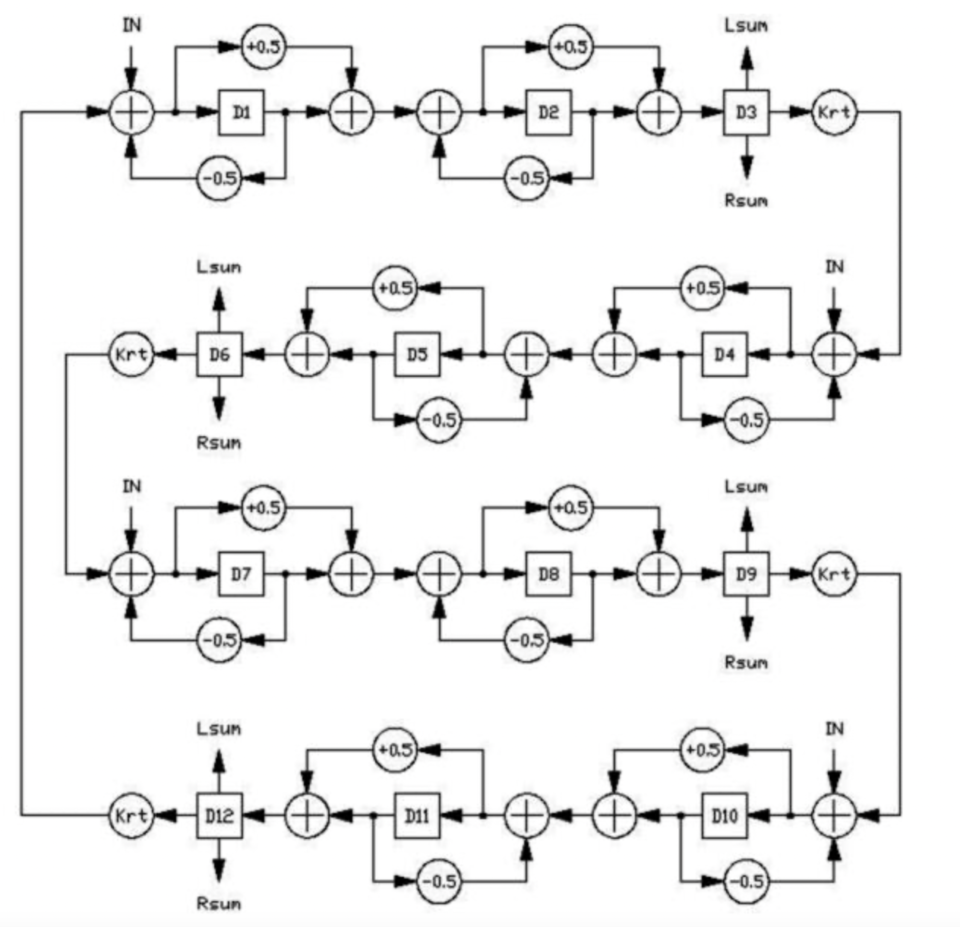
Plugin Schematic

There are many online resources available for people interested in reverb design. Here are a few of my favorites:

The Spin Semiconductor website

In the late 2000s, Keith Barr (of MXR and Alesis fame) and Frank Thomson formed a company focused on their new chip design, the FV-1. This chip has a fairly simple architecture but can be programmed to make excellent effects and currently powers a ton of boutique reverb and delay pedals. The Spin Semiconductor website has a wealth of information about using the FV-1, including some “informal notes” that provide one of the best walkthroughs of allpass loop reverbs ever. I would recommend picking up the FV-1 Development Kit and loading up all the example algorithms from the Spin Semiconductor website to see how they work, as these examples greatly expand upon the basic allpass loop concepts.

Theory and Techniques of Electronic Music by Miller Puckette

Puckette has been designing reverbs since the early 80s when the Stautner/Puckette algorithm was published in the Computer Music Journal. His online textbook is an embarrassment of reverb design riches, as well as musical DSP in general. Puckette has an excellent explanation of how feedback delay networks work, as well as going into depth on the use of rotation matrices in reverb design and how rotation matrices correspond to allpass delays. The primary reverb example uses both a feedforward unitary delay network for early reflections and a feedback delay network for late reverb. The Pure Data examples have several more explorations of FDN designs.

Physical Audio Signal Processing by Julius O. Smith

Smith has been publishing interesting reverb topologies since 1985, and this online (& physical) book is a great overview of his work. Smith goes into depth about comb and allpass delays, feedback delay networks, waveguide reverbs, and the various equivalences between these methods.

Digital Audio Effects (DAFX) Conference

The Digital Audio Effects (DAFX) conference has been held every year since 1998, and the proceedings from the conferences are a treasure trove of modern reverb research. Not all of the links are working on the page, but it is entirely worth tracking down EVERYTHING published at these conferences and giving it a read, or at least a glance (lots of good non-reverb papers).

The Journal Of the Audio Engineering Society E-Library

Normally I wouldn’t want to recommend a source behind a paywall, but there are tens of thousands of amazing papers here, dating back to the 1950s.

Your local university library

OK, that doesn’t seem like an online resource, but hear me out. There are a lot of important reverb articles that have been published in journals like the Journal of the Acoustical Society of America, the IEEE, and the Computer Music Journal. Buying articles from these journals individual is expensive. However, odds are high that your local large research university subscribes to these journals, and has access to these online archives through their library system. For the past 15 years, I’ve walked to the University of Washington with a USB stick, sidled up to one of the public access terminals, plugged in a USB stick, and looked up and downloaded the papers I need. I’d highly recommend looking into the public research facilities in your area!

Getting Started With Reverb Design, Part 2: The Best Papers

Sonic schematic

Best Academic Papers on Digital Reverb

Digital reverberation algorithms are a relatively young technology. The first published works in this field date to 1961, but it wasn’t until the late 1970s that the first commercial digital reverberators became available and would be heard on popular recordings. There have been a lot of great papers published on the topic of digital reverb, but there are 10 papers that, in my opinion, can be considered the foundations of all algorithmic digital reverbs that followed.

“Colorless” Artificial Reverberation by Manfred Schroeder

Journal of the Audio Engineering Society, 1961. This paper was the first one (as far as I know) to introduce the idea of digital reverberation, as well as the allpass delay line. Schroeder showed how to use both feedforward and feedback around a digital delay, to create a “colorless” delay block, in that it passed all frequencies at unity gain. These allpass delays could be cascaded, with each one increasing the echo density without adding coloration. The resulting reverberator structure is a bit hard to tune, as both the reverb attack and decay are controlled by the feedforward/feedback allpass coefficient, and is less “general purpose” than the structure discussed in Schoeder’s next paper. However, there are many modern reverbs that extend upon the basic concepts in this paper, by connecting a high number of allpass delays in series, and embracing the weird and wonderful results.

Natural Sounding Artificial Reverberation by Manfred Schroeder

Journal of the Audio Engineering Society, July 1962. In this seminal work, Schroeder extended upon his cascaded allpass delay work from the 1962 paper, and showed how to combine comb delays with short allpass delays. This architecture, which is what is commonly referred to as the “Schroeder reverb” nowadays, uses parallel comb delays of different delay lengths, where the feedback is used to control the overall reverb decay (more feedback = longer delay). The outputs of the parallel comb delays are summed together, and sent through two short allpass delays in series. The short series allpass delays increase the echo density – this is a technique used by reverb developers to this day. Schroeder also shows how to transpose the order of the series allpasses and parallel combs, where the outputs of the parallel combs are combined in a matrix to obtain decorrelated multichannel outputs. Again, this is a useful technique today.

Synthetic Stereo Reverberation (Part 1) by Michael Gerzon

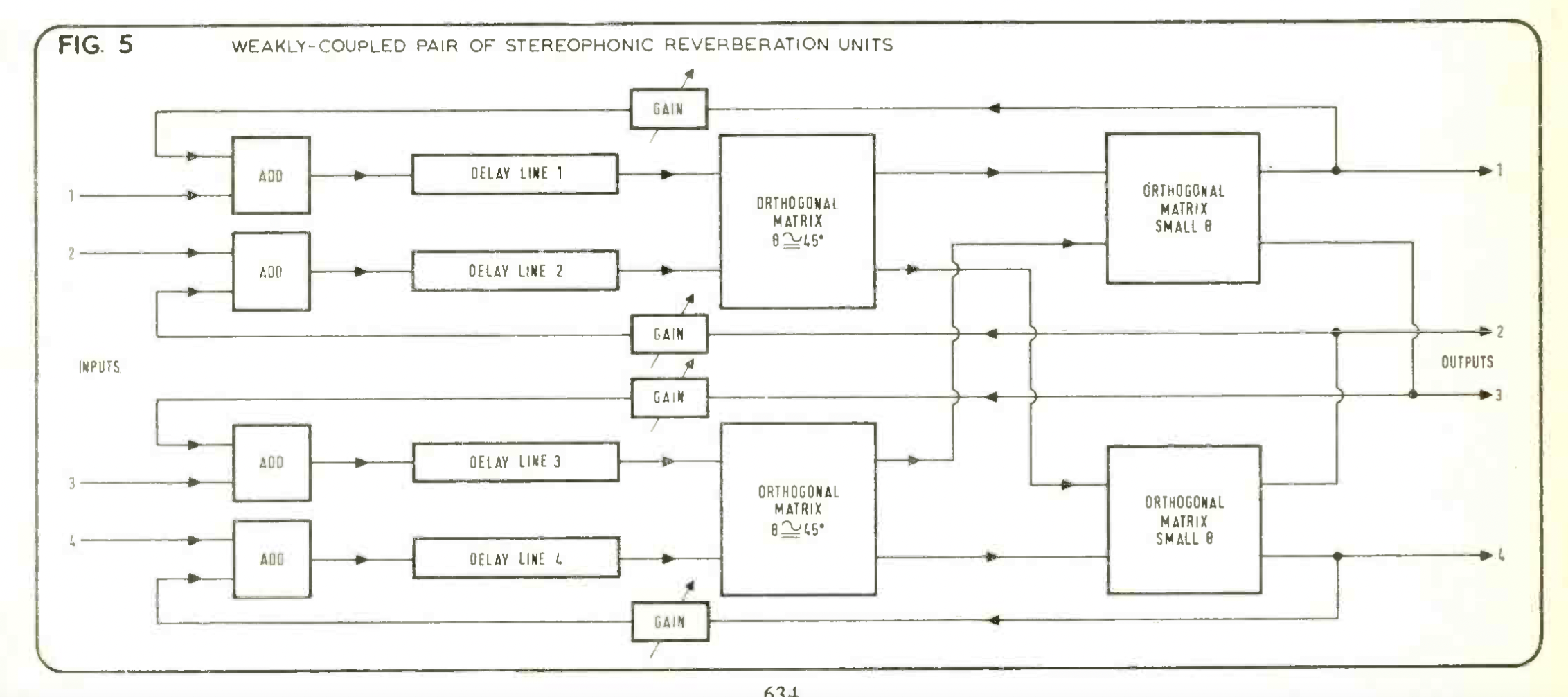
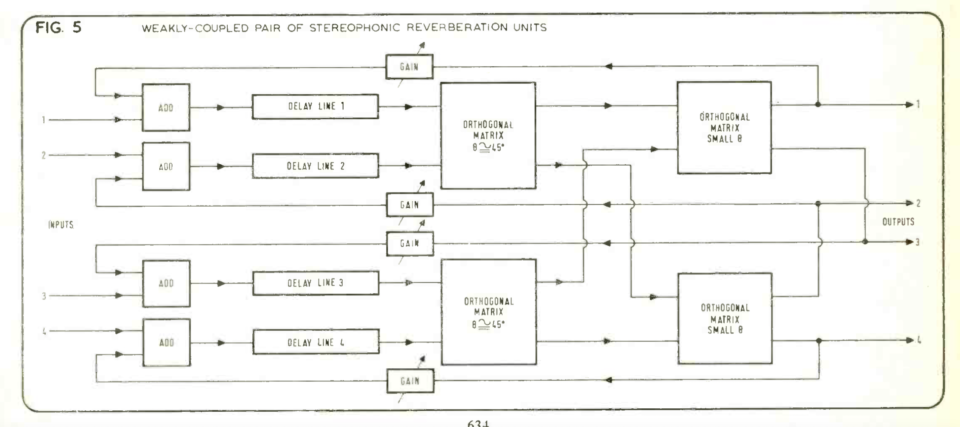
Studio Sound, December 1971, pp. 632-635. This paper was so ahead of its time that it blows my mind. In this paper, Gerzon establishes the concept of feedback delay networks, where several parallel delays are combined with a unitary matrix (orthogonal in Gerzon’s paper), and the outputs of the matrix are sent back into the delay inputs. This creates a stable reverberator, where the echo density grows over time – a characteristic found in a real acoustic space, but not in the Schroeder reverbs. Gerzon shows how to create a higher order unitary matrix out of 2×2 rotation matrices, and how to use the rotation angles to control the spread of reverberation between the left and right channels – a useful trick to this day.

Synthetic Studio Reverberation (Part 2) by Michael Gerzon

Studio Sound, January 1972, pp. 24-28. I first read this paper 20 years ago, and am still learning new things from it to this day. In this paper, Gerzon takes the concept of feedback delay networks from his previous paper, and extends it to allpass feedback delay networks and cascaded unitary networks. Gerzon also describes how to add filters within these unitary networks to obtain a frequency dependent decay time, as found in a real acoustic space, and even describes how to replace the feedforward & feedback multipliers of an allpass delay with filters in such a way that the output is still allpass. This quote is very simple, but understanding the ramifications of it can fill a lifetime of reverberator design: “By repeated applications of feedback networks and of cascading, a wide variety of unitary networks can be created out of just a few basic unitary circuits.”

About This Reverberation Business by James Moorer

Computer Music Journal, June 1979. Moorer’s paper starts with the basic concepts from Schroeder’s work, and extends it in several ways. The 2-multiply allpass delay used by Moorer quickly became adopted as a standard building block, as it is more efficient than the Schroeder 3-multiply allpass. Moorer proposes using lowpass filters within comb filters to more accurately model high frequency damping, and also uses a sparse FIR filter (i.e. a tapped delay line) to directly model early reflections while using the comb/allpass networks for late reverberation.

Designing Multi-Channel Reverberators by John Stautner and Miller Puckette

Computer Music Journal, Spring 1982. The Stautner/Puckette paper is notable for introducing the concept of feedback delay networks to a wider audience. Gerzon had proposed these concepts in 1971, but in a publication (Studio Sound) that was virtually unavailable in the United States, so the Stautner/Puckette paper can be viewed as a case of convergent evolution. I have a soft spot in my heart for this paper, as it was the first reverb algorithm I successfully implemented, using Csound in 1999. The algorithm in the paper comes with Music 11 source code, so it is easy to adapt to other platforms. The Stautner/Puckette paper was the first one I know of to feature slow delay length modulation as a way of improving the sound, although this had been used in commercial reverbs since the EMT-250 in 1976. Low-frequency random signals are used to modulate the delay lengths, and the settings in the paper sound really nice.

A New Approach to Digital Reverberation using Closed Waveguide Networks by Julius O. Smith

Proceedings of the 1985 International Computer Music Conference, Vancouver. 1985, pp. 47–53. Julius’ paper introduces the idea of using waveguides (bi-directional delay lines) to construct reverberators. Lots of cool illustrations in this paper, with amazingly convoluted spaghetti nests used for reverb. Many of the concepts in this paper were later adapted to feedback delay networks, including using a “waveguide junction” as a scattering matrix, as well as some of the modulation techniques suggested by Smith.

Digital delay networks for designing artificial reverberators by Jean-Marc Jot and Antoine Chaigne

Proc. AES 90th Convention, Paris, France, Feb. 1991. In this paper, Jot and Chaigne introduce the concept where every delay line in a feedback delay network has its own damping filter, where the damping is designed so that all the delay lines have the same decay rate for all frequencies. This is intended to reduce metallic resonances in the decay, where some eigenmodes decay at a longer rate than others. Jot has continued to publish useful reverb papers for the past 30 years – his website is a treasure trove of reverb design content.

A Realtime Multichannel Room Simulator by Bill Gardner

Presented at the 124th meeting of the Acoustical Society of America, New Orleans, November, 1992. Gardner’s paper serves as the first public introduction of the type of reverb I refer to as an “allpass loop.” These reverb consist of several allpasses in series, embedded within a larger delay loop, where the feedback gain around the loop determines the decay time. Gardner gives specific examples of allpass loops for small, medium and large reverbs, and also discusses using nested allpass delays, which consist of allpass delays embedded within the feedforward/feedback loop of another allpass delay.

Some of these concepts were discussed in Gerzon’s 1972 paper, and Gardner mentions that he first learned many of these ideas while working in the electronic musical instrument industry. However, as far as I know, Gardner’s paper was the first time that these concepts were discussed in public literature. Gardner’s paper is also a useful reference for using a single memory buffer, and reading from and writing to that buffer to create allpass delays, nested allpass delays, and larger feedback loops.

Effect Design, Part I: Reverberator and Other Filters by Jon Dattorro

Journal of the Audio Engineering Society, Vol. 45, No. 9, September 1997. Whereas Gardner’s paper alludes to concepts that had been privately circulating within the music technology industry, Dattorro’s paper fully opened the vault doors on the allpass loop reverbs. Dattorro’s introduces a specific allpass loop reverb in great detail, complete with all delay lengths and coefficients, “in the style of [Lexicon’s] Griesigner.” This paper can be viewed as a Rosetta Stone of reverb design, and many plugins and built-in synth reverbs have exactly recreated the “Dattorro” reverb. Dattorro also includes very informative comments from Barry Blesser, the designer of the EMT-250 reverb algorithms, that explain why delay line modulation was originally included in commercial reverberators. A must-read paper.

Getting Started With Reverb Design, Part 1: Dev Environments

You can design reverb algorithms

Over the years, I’ve received many questions from people who want to try their hand at developing reverb algorithms. In many cases, people have qualified their questions with “I’m not an EE, but…” Well, as an Anthropology major, I can attest that you can design reverbs without having to go through an intensive 4-year academic program!

Set up a development environment

In my opinion, all the theory in the world is useless without being able to HEAR the results. So my suggestion is to start your reverb development path by setting up one or more development environments. Ideally, you want a place where you can hear your work in near-real-time, and run the audio of your choice through your algorithms.

Already know how to code? Use Juce!

Great! My recommendation is to download the Juce SDK. Juce is the framework used by many plugin developers to create their plugins. It is used to handle both the audio and visual parts of the plugins, has target for all of the popular plugin formats (AU, VST2, VST3, AAX, Mac, Windows, Linux, iOS, Android), and is free and open-source to get started.

Once you get a plugin you want to release commercially, Juce has several options to pay for using the code for closed-source plugins. I would highly recommend installing the Juce SDK, compiling the example plugins, and modifying the example plugins as the start to your own plugins.

Don’t know how to code? Check out a computer music language.

My suggestion is to work with a computer music language/environment, so you can start learning the fundamentals of digital signal processing and algorithms without having to understand code. When I started programming reverbs in 1998, I was using Csound. This was an old school language even in 1998, but it had all the building blocks I needed to make reverbs:

  • Delay lines. A “delay line” allows you to read from and write to a memory buffer and increment through that buffer every sample. The distance between your read and write points determines how much the signal is delayed from the input to the output. An algorithmic reverb will have several to several dozen of these, all at different delay lengths.
  • Filters. A digital filter is used to control the high and/or low-frequency balance of a signal. In a digital reverb, filters are often placed in the feedback path of a delay, where the signal is filtered, scaled by a value, and added back into the input.
  • Modulators. Many digital reverbs (including all of the Valhalla reverbs) will slowly vary the delay lengths over time. This requires fractional delays that use linear or higher-order interpolation, but that’s a concept beyond this introduction. The important point is that you need some sort of modulator to vary things slowly. These are often low-frequency oscillators or some sort of band-limited noise.
  • Add/subtract/multiply. These are the building blocks for creating feedback around the delays, as well as feeding a signal around a delay (as found in allpass delays), scaling the outputs of the reverb, and creating matrices for mixing signals together before they are fed back into the inputs, stuff like that.

Today, you have many real-time options to experiment with these fundamental computer music building blocks. Most modern music DSP environments use a visual environment to patch signal processing modules together in a similar way to an analog modular synthesizer.

  • Pure Data is a free, open-source real-time computer music environment that runs on pretty much everything – Windows, Mac, Linux, embedded hardware, you name it. It isn’t the prettiest language from a visual standpoint, but it is very powerful. For reverb development, you’ll want to use of the Pd-Extended branches, and find something that has an allpass~ unit generator, as this is a CRITICAL building block for algorithmic reverbs.
  • Max/MSP is a commercial, closed source, prettier version of Pure Data. It has nice delay and allpass ugens built in. More importantly, it has several decades of useful example code.
  • Max4Live is a fairly recent adaptation of Max/MSP that runs as audio and MIDI effects inside of Ableton Live. It is a VERY powerful environment to get started in, especially if you use Live as part of your musical workflow. I started working with Max4Live in early 2020, to create some examples for lectures at the University of Victoria in Victoria, BC. It took me about a week to get up and running. By the time I gave the lectures, I was able to develop a few algorithms that became the core of ValhallaSupermassive. You can get a LOT done in Max4Live.
  • Bitwig Studio was recently updated with the Grid environment, which has 170+ DSP blocks that can be patched together in a visual environment. I haven’t tried this yet, but I’ve heard other people having success patching together reverbs with the allpass delays.
  • Reaktor has had some nice reverb examples for the last few decades, so it is worth downloading the various reverbs in that environment and opening them up to see how they work.

Want to learn how to code? Focus on C++.

Most of my DSP code is in C++, although it is closer to “C with classes” – I tend not to use advanced C++ functionality in my low-level DSP blocks. C++ is used for Juce, and for many other audio SDKs, so learning C++ will be super useful.

Working in a visual DSP language can be much faster than getting up and running versus a text-based DSP language. It is much quicker to prototype a simple reverb in Max/MSP or Max4Live versus creating an entire DSP and GUI code base in C++.

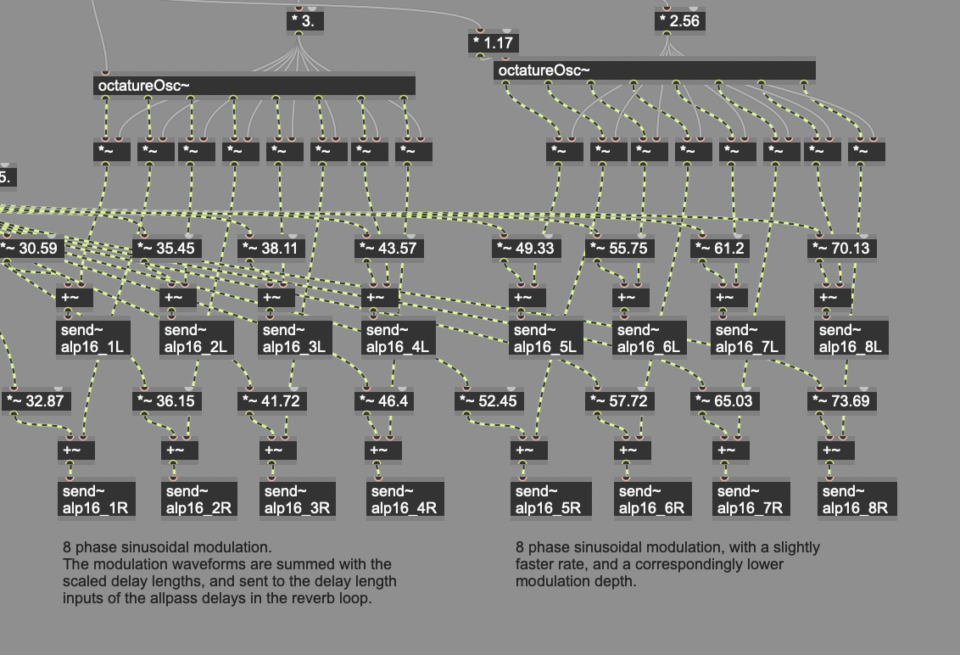
The drawback of a visual language is that a complicated reverb will quickly turn into something that looks like a pile of necklaces that have become knotted together – it is difficult to follow. Text bases languages usually have the benefit of having for() loops or something similar to churn through repetitive actions, which is a lot of what reverbs end up doing. Still, if you are just getting started, I’d highly recommend trying one of the visual languages, and seeing how far it can take you.

Sean Costello Max4Life reverb
A small snippet of one of my Max4Live reverbs.

In my next blog post, I’ll list what I consider to be the “canonical” papers in reverb literature. Thanks for reading!

Plugin Design: Rescue Your Darlings

What do you do when you love one of your own creative ideas, but that idea is getting in the way of finishing up your creative project? This is something I have run into several times while working on Valhalla plugins. I have an idea that I fall in love with and it becomes the centerpiece of a product in my mind. I put that idea in a plugin, have a few people beta test it, and…it just doesn’t work. Maybe it breaks the “flow” of the plugin. Maybe it breaks the plugin itself, in that it causes hard crashes. Maybe it just doesn’t work for that particular plugin, for whatever reason.

There is a saying in literature: “kill your darlings.” This phrase has been attributed to all sorts of writers famed for their terse prose, but it probably has its origins in the 1914 essay by Sir Arthur Quiller-Couch, “On Style”:

“Whenever you feel an impulse to perpetrate a piece of exceptionally fine writing, obey it—whole-heartedly—and delete it before sending your manuscript to press. Murder your darlings.

The Origin of Valhalla Delay

ValhallaDelay had an unusually long gestation. I started the initial tape delay algorithm work in 2014. I began working on the plugin in earnest in 2016. By 2018 I had a working version with GUI that was undergoing extensive beta testing. But it was FAILING beta testing. Lots of crash reports. It turns out that all the crash reports could be traced back to the Matrix Style. This was my FAVORITE delay style: 4 delays in parallel, that a variable unitary matrix could mix together, and with the delay lengths adjusted via a Warp control for all sorts of cool sounds.

What was I going to do? I really loved this particular style, but it was CRASHING. Everything else in the plugin worked. In addition, the Matrix Style didn’t really work with the other styles in the plugin – it took it out of “echo/delay” mode, and into some other sort of thing that was cool, but not in keeping with the rest of ValhallaDelay. So, I took a deep breath and Killed My Darling Matrix Style. As soon as I did that, the crashes went away, and the plugin was on its way to being finished.

So, why isn’t this essay called “Kill Your Darlings”? I mean, that’s a catchy name right there. But it only tells part of the story. I kept thinking about the cool sounds of the Matrix style, and thought I might revisit these concepts in the future. And then COVID happened. We were all stuck indoors, I had no idea what would happen to the business, and I needed a PROJECT to keep my mind busy.

The Surprise of Valhalla Supermassive

Right before everything shut down in March 2020, I traveled up to Victoria, British Columbia, to give a few lectures at the University of Victoria (so much fun – I want to return someday!). As part of these lectures, I created a few example reverbs in Max4Live to show the class. One of them had a bunch of allpass delays in series, with the spacing controlled by a Warp control. As soon as the shutdown happened, I started working on a new plugin called ValhallaSupermassive, which allowed me to play with various feedback delay configurations.

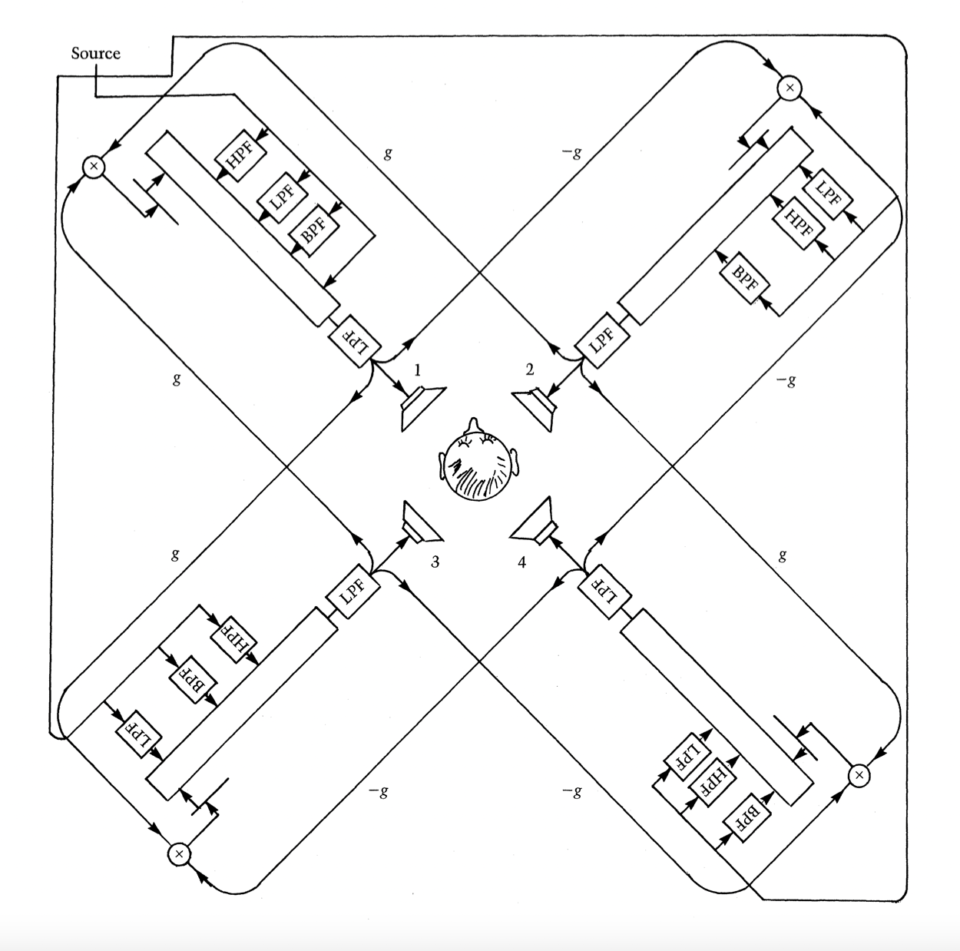
It turns out that ValhallaSupermassive was a MUCH better home for the Matrix style ideas than ValhallaDelay would have been! I was able to try the basic “4 delays in parallel with warped delay lengths and variable scattering matrix” in the Supermassive Lyra mode, but was able to expand this to larger numbers of delays in parallel. I extended this to all sorts of series/parallel/nested combinations that allowed me to try out all sorts of Michael Gerzon-influenced structures that didn’t have a home in a “standard” reverb.

Michael Gerzon Delay Reverb

The moral of the story? Sometimes an idea isn’t right for a given project, and it is OK to put it down. That idea might find the ideal home in a future project. It’s best to let the project come to shape around the idea, versus trying to shoehorn an idea into a project that wants to be something else. Don’t kill your darlings – rescue them for another day.

Plugin Design: Going Outside

“August rain: the best of the summer gone, and the new fall not yet born. The odd uneven time” – Sylvia Plath, The Unabridged Journals of Sylvia Plath

I get all wistful during the last days of Summer . . .

August is always a melancholy time of year for me. The summer days seem to stretch on forever, but here in the Pacific Northwest, the days are getting noticeably shorter. We’re reaching the peak of the summer heat, and yet there’s something in the sky and air that makes me sad and a little nervous.

Undoubtedly this is partly a learned reflex from going to school as a youngster. Early August marked the “less than half of your summer left” point. As much as I would enjoy rafting down the Sammamish River, riding my bike, or just lying around eating taco-flavored Doritos while reading National Geographics, it was clear that the endless summer was gonna end soon. Our shadows were growing longer.

This anxiety isn’t simply cultural but also stems from some deep-rooted biology. There’s an explosion of activity in the natural world during August.

Today on my hike, I saw hundreds of dragonflies in metallic blues, greens, and copper.

Dragonfly

The blackberries are at their ripest this week, and I dined upon them like an overly fussy bear fattening up for the winter.

Blackberries

There are golden grasses that have grown far over my head, with vibrant green growth near the edge of a dried-up pond.

Meadow Path

Birds and bugs are flying around everywhere. And yet, in a few months, this whole area will be a muddy wetland. The dragonflies will disappear, the bugs will go away, and the birds…well, most of them stick around here, but they’re gonna be COLD.

Creativity vs. Productivity

So, what is my creative goal for August? Honestly, it’s to soak up as much of the August sun as I can, and get outside while it is still warm and the wildfire smoke hasn’t rolled in yet. I’m working on separating creativity from productivity, and I’ve realized how vital it is to take care of your soul to be creative. This is the time to store good memories, go on long walks to clear my head, and focus on getting my mind and body as healthy as possible. These summertime experiences will be the creative stores to keep me going through the long winter ahead.