Last week, I went tent camping for the first time in four years, on the shores of beautiful Lake Wenatchee. The campsite was nestled among towering Douglas fir and Ponderosa pine trees. Due to the dry conditions on the east side of the Cascade Range, there were no campfires around. This meant that people went to bed early, with no crackling fires, and none of that lovely campfire smell. We were able to fully experience the forest with all senses: the smell of the pine trees, the sound of ravens and ground squirrels, the feel of the sun on our skin, the clear blue of the sky during the day and the bright moonlight at night, and the taste of bacon (I can’t go camping without frying up some bacon in a cast iron skillet on a propane stove).
Shinrin-yoku or Forest Bathing
I recently learned a great word that describes the act of immersing oneself in the woods and soaking up the atmosphere: Shinrin-yoku, which roughly translates as “forest bathing.” Shinrin-yoku takes a very different approach from the more goal-oriented hiking and climbing that I grew up with in the Pacific Northwest. The focus is on leisurely walks, and simply “being” in the forest. Dr. Qing Li has written an excellent book on the subject,”Forest Bathing: How Trees Can Help You Find Health And Happiness.” I’d highly recommend seeking this out at your local bookstore, but you don’t need a guide for this process (which is good, as I misplaced this book in a backpack for this last trip). Just head to the woods, walk around, and let yourself experience the woods with all senses.
The visual, tactile and olfactory aspects of the woods were greatly appreciated during my forest bathing experience (I didn’t taste any trees). But on this trip, nothing compared to the sound of the woods. There was a fair amount of wind blowing off of the lake, and it created the most immersive spatial audio experience of my life. We’d hear the wind starting to pick up from a distance, and then blow over and around us. Radically different washes of noise could be heard at different angles and distances. The tent blocked NONE of the sounds of the wind in the trees. There was none of the typical campground noise – no music, no cracking fires, nothing. Just the wind blowing though pine needles.
Psithurism, the sound of the wind rustling in the leaves
It turns out that there’s a great word to describe the sound of wind in the trees and rustling of leaves: Psithurism. This word comes from the Greek psithuros, meaning “whispering, slanderous.” Each tree will have its own distinctive voice. There was a beautiful poplar in our neighborhood that would catch even the slightest breeze and turn it into a melodic rustling. The pines and Douglas firs at our campsite created less granular sounds, and more of a wash that would vary in pitch and direction. John Muir wrote about how “…the pines seem to me the best interpreters of winds. They are mighty waving goldenrods, ever in tune, singing and writing wind-music all their long century lives.” (A Windstorm In The Forests, 1894)
I love going for long hikes, getting my pulse rate up, climbing ridges and seeing huge expansive views. But there is a lot to be said for just sitting down in the forest, and soaking it all in. When I was in the woods, I wasn’t thinking about the news or allpass delays or changes to Apple OSes or anything like that. For the first time in a long while, I was just able to sit and observe and be. I came back from our camping trip recharged, with a clearer mind than I have had in a long, long time.
One of those strange factoids I’ve picked up over the last few decades of my life is that frogs don’t see things the way we see things. Frogs have excellent color vision and can see colors at night, but the most important distinction (at least for this blog post) is that frogs primarily hunt via the perception of movement.
The frog does not seem to see or, at any rate, is not concerned with the detail of stationary parts of the world around him. He will starve to death surrounded by food if it is not moving. His choice of food is determined only by size and movement. He will leap to capture any object the size of an insect or worm, providing it moves like one.
In other words, when a frog spends hours staring into space, what stands out for them is what changes in their vision.
Testing Reverbs with Tom’s Diner
I have found myself in a similar situation over the last few decades when testing reverbs. When I am listening to a new reverb algorithm, I tend to use the same source material repeatedly. My standard test suite consists of some vocal tracks from Don Gunn, a single sample click, dry piano recordings (to hear the effects of modulation on the signal), dry drum tracks, and the old standby of DSP developers: “Tom’s Diner (A Cappella)” by Suzanne Vega.
The ubiquity of “Tom’s Diner (A Cappella)” as a test signal has become an in-joke among audio DSP developers. In 2001, I heard a composition from a DSP developer at Creative Labs at a Santa Cruz concert, made around manipulations of “Tom’s Diner.” Many of the folks in the audience had a knowing chuckle, as they had heard “Tom’s Diner” playing soooooo many times in their office. Twenty years later, I still turn to “Tom’s Diner” all the time for testing new algorithms.
Why “Tom’s Diner”?
In many ways, it is ideal for all sorts of audio DSP testing. It is a solo female voice, with almost no reverb applied, recorded in a professional environment. This is perfect for testing pitch tracking, PSOLA pitch shifting, reverbs, compression, and so on. However, the most important factor for me is that I have heard “Tom’s Diner” so many times that I no longer hear it. Like frog vision, I no longer notice what remains the same, only what has changed. I don’t hear the song anymore, just the different ways that my DSP algorithms respond to it.
Observing Nuances in Sound through Repetition
I’ve been working on DSP algorithms since 1998. I’ve learned a lot over the past 23 years. Perhaps more importantly, I’ve learned to observe sound to a degree I would never have imagined back in the 90s. By listening to things obsessively, day in and day out, I can hear more and more nuances in my algorithms. These observation skills have led to me (hopefully) producing better algorithms. By using that same dang Suzanne Vega track repeatedly, I can focus my observation on things that have changed between different algorithms or different variants on the same algorithm. The repetition can be maddening at times, but the results are worth it.
Way back in January, I wrote about desert island tools. One of my goals was to set up a toolset that would work for me on a “desert island.” My secret goal was to create a portable electronic music setup so that when things opened back up, I could go out to the woods and make some music. I had a little fantasy about being in a log cabin in the mountains, overlooking trees and a river, and letting the scenic natural beauty inspire me to great heights of creativity.
Something like this would do nicely…
A Minimal Electronic Music Setup
Flash forward to a few weeks ago, when we spent the weekend in a cabin in the Lake Wenatchee area of Washington State. I decided to bring a small electronic music setup with me, to work on some tunes. I left my Intellijel Palette 101 at home, as I wanted to have something lighter weight. My setup for the trip:
Roland SE-02. This synth can hook up to a computer via USB, without needing a separate audio interface.
Headphones, power supplies, USB hub, etc.
After a few hours, we arrived at the cabin. It was PERFECT: a log cabin in the mountains, overlooking pine trees and the Wenatchee River. I brought in my bag of music gear.
And then didn’t touch it for the entire weekend.
What happened? Where did my “desert island music” dreams go?
Quite frankly, once I was in the woods, I wanted to BE IN THE WOODS. I’ve been shut indoors, surrounded by synthesizers and computers, since March 2020. I’ve had plenty of synthesizer time. Now that I could leave the house, I wanted to focus on being outside the house. I wanted to be out in nature. I wanted to go for a hike. I wanted to sit on the porch, drink a Paloma, and stare at the swiftly flowing river. This trip didn’t inspire me to sit down and make music. It just inspired me, period.
Inspiration Back Home
We got back home Sunday evening. The next day, I found myself playing around with theIntellijel Palette 101, the synth I had put together back in January for the purpose of “mobile music.” I created a patch that used voltage-controlled wave folding to simulate through-zero FM. This is a tweaky academic concept, but it sounded cool. I added ValhallaDelay for looping and other stuff. At some point, I decided just to hit record. 20 minutes of playing and mixing later, and I had my first piece of music in a few months.
Moral of the Story
The moral of this story is? Getting outdoors can be truly inspiring. But inspiration can happen on a macro scale, not just in that specific moment. When I was out in the woods, I didn’t want to touch my computer or synths – I just wanted to soak in nature and recharge my batteries. Once I got back home, I was able to approach music with a new perspective. I realized that taking care of myself helped me with my long-term creativity, even if I wasn’t actively making art in the moment.
Tell us about you as an artist and how you’ve evolved over time.
I’ve always considered myself an introvert who welcomes company. To put it differently, by choosing to be a drummer, I get to be involved in group settings without having to say much. I just listen, lay a foundation and try to be supportive. I’m sure it has a lot to do with being an only child and content with solitude, but I always look forward to working with others when the opportunity arises.
For as long as I can remember, I’ve paid attention to how my bandmates work with the equipment they use, the session musicians I’ve met, the producers, the engineers, and their studios. All because I’m interested in the whole process. That exploration, education, and constant gear talk have helped me contribute more and more to the big picture, not only as a drummer but as a writer and an engineer.
What mediums do you work in? What draws you to them?
When I was a kid, I loved to design and build things. Lego bricks, sticks in the woods, a new instrument, or just a pencil and paper – just the concept of creating something from nothing, or with whatever you had on hand, was inspiring. Even as an adult, I still love to imagine and construct ideas in mental and physical forms, and the more creative the better. Balance, patterns, mechanical reasoning, symmetry, asymmetry, texture, landscape, dynamics – solving the puzzles and patterns of life has always kept me focused and helped me to recognize the importance of personal growth.
When the things you build bring people together, it’s the best feeling in the world. Whether you’re a teacher sharing knowledge with a student, or you’ve assembled an audience at a historic venue to play sounds and songs created with your friends, that’s an incredible gift and will always be a part of my continuing education.
Which of your works best represents your past, present and future selves?
Any of the Death Cab for Cutie albums from “Transatlanticism” (2003) when I joined the band to the present day, Tegan & Sara’s “The Con” or “Sainthood”, Matt Nathanson’s “Some Mad Hope” or “Modern Love”. More recently a trio side project I’m a part of called The Overstory released an EP, and the latest Death Cab releases, The Blue EP and The Georgia EP, the second of which I tracked all the drums for at my home studio. All are good examples of what I do.
Where do you work?
When I’m not on tour with Death Cab, I usually work from my home because all the instruments I own are within reach. If I have a snare sound in mind, I’ll grab one of the 20 or so drums from the shelf, or swap kick drums, cymbals, or even pick up a guitar, a bass, sit at the piano, or whatever I’m inspired to play.
Obviously, I’d always rather be in the same room as whoever I’m working with, but having my own space is really beneficial. Not to mention, I trust 100% of the sounds I’m getting will translate my intentions, whether I’m sending out raw files or mixing drum stems or a full song. It’s also easy enough to jump online in real-time for a pass or two with the other musicians or producer to talk about approach or swap out drums while sending my studio audio for reference. If I need to be in a studio space in Seattle it’s a short drive, while LA and Nashville are easy flights.
What’s your studio like?
I have an elongated 400 sq ft room in the basement of my house. The walls, floor, and ceiling are 50% concrete and stone, 50% floated THX QuietRock, and the surfaces are heavily treated with a combo of diffusion and absorption, making it as flat and even as possible. My desk and outboard gear are in the middle of the room with two kits set up in different places; a bigger kit having 12 mics in a more open section of the room, and a tighter, smaller, drier kit with 3 mics in a narrow section of the space.
I also have a single-mic cocktail kit with percussion around it for overdub ideas. The room provides plenty of low end in the kick and toms, with just enough ceiling height so that the cymbals and snare drums aren’t overbearing. There’s also a door to a concrete utility room at the far end of the studio that makes for a killer natural reverb chamber – you could say it’s my AMS-NonLin-Boiler-Room-Plate-Flavor-Du-Jour! I often re-amp drum sounds through guitar cabinets in that utility room for extra depth.
Every instrument is always mic’d up, patched, with session templates ready to go. My outboard is a combo of tube and solid state, vintage and modern, with just enough knobs to have flavor choices, but not enough to create option anxiety. I leave the rest to plugins and the mix phase. All I have to do is walk in, sit down, open a session, and hit “Record”.
I firmly believe the fewer obstacles one has, the easier it is to capture the purest moments of inspiration and creativity. Workflow is key!!!
What would your dream studio look like?
Maybe a seaside Pacific Ocean perch like Tony Stark’s house? No, seriously, my dream studio wouldn’t be much different in terms of layout, with a single medium-sized tracking/mixing room, but I’d like to have higher ceilings and a little more old wood in the construction and to be tucked away in the trees somewhere. A detached building would be ideal for those days I’m inspired to make noise before the sun rises or my family wakes up! I do have the option to put a building on my property, so someday I might build out, but hopefully, I won’t lose any of the mojo or good vibe I’ve already got!
What are your favorite tools/instruments?
I have a lot of instruments in my studio, but mostly drums and cymbals, ranging in age from the 1920s to modern day, each with their own special “thing”, but to list favorites would be difficult. I can say the things that weren’t my favorite have been sold or traded over the years, but the current collection is all very usable to me.
I had an 8 channel Quad Eight sidecar built from some leftover channel strips that’s pretty special. It has an 8 slot 500 series rack built-in and also a master section, making it a stand-alone 16 channel console if need be. Those Q8 preamps and EQs sound killer, not to mention it’s a really unique piece to have in the studio. Some of my other favorite things are the Overstayer Stereo Modular Channel, a pair of Spectra Sonics c610’s, my JFL Audio MP-F4 (Frank Lacy) tube mic preamps, some rare RESLO ribbons, and a sweet old AKG D-25 micthat I recently picked up.
Is there a tool or instrument you would invent to aid in your work/inspiration?
Maybe a second brain? Hahaha! A studio clock that I can use to travel back in time to give me HOURS of my life back? Or an invisible intern that could magically move every microphone to be perfectly in phase with one another and allow all my faders to be at unity, no matter how light or hard I play? That is possible, right?
Actually, I think that having the right amount of wrong is where inspiration and creativity come from, as well as having limitations and time constraints.
How do you start a project? What happens next?
Death Cab songs usually start with a fairly realized demo from Ben (Gibbard) or just a musical bed from somebody else in the band that we’ll pass around. Even though each of us is capable of engineering and playing all the instruments, we’ve learned to leave room for each other’s ideas. A song might get passed around for a few revisions, but the goal is to get it to a place where we can all be in the same room knowing the arrangement; at that point, it’s about documenting the best sounds and performances.
If I am tracking drums for somebody else, I always start by asking for a few stems, one for music and one for whatever rhythmic component, track, or idea that’s been suggested. Sometimes I will ask for individual audio files or layers to have better control over monitoring and mixing roughs, but as long as I can hear how to best fit into the big picture. Additionally, I’ll request a playlist or production references so I don’t waste my time chasing ideas that aren’t going to work, especially if I’m not in the same room as the client.
Another way I’ve started projects is by creating folders of drum loops, at various tempos, varying in sound design and vibe. These are analogous to building blocks you’d drag and drop to help create a template for writing, or at least use to hang a song or riff on. Obviously, there are a number of content and loop libraries out there that sound great, but this all goes back to my being a kid and being inspired by creating something out of nothing. Sometimes it is an idea that starts at midnight by routing a Korg Volca through the Valhalla Delay LoFi-DirtyLooper preset, which leads to additional programming or opening Kontact, picking up the bass, the acoustic guitar, and sitting at my drums last…finishing at 4 am. Because when there’s a spark, you gotta chase that fire. Don’t second guess yourself!
Do you notice consistent phases in your work process, or is it different every time?
The recording process is pretty much the same whenever I’m working solo, or in the ways I’ve just described. Sometimes I write around a drum hook or search for a creative processing vibe, routing through pedals, amps or plugins, to arrive at something that feels inspired and fresh. Sometimes I work really fast within a set time limit, or if I don’t have a lot on my plate, I may keep a track open for a full week and continue to tweak it each morning with fresh ears until I feel like it’s done.
When it comes to practicing my instrument, that definitely has phases or seasons. I often put my head down and commit several hours a day for weeks at a time, challenging myself with new exercises or studying with somebody who inspires me. But then there are inevitably periods of rest when I’m less concerned with clocking in hours on the drums and instead would rather spend my time doing other things.
What do you do when you need to create something but aren’t feeling creative? How do you get unstuck?
Whenever I’m in a rut or not inspired in the studio, I find a few things always help.
The first thing is to revisit those formative albums that have had a major influence on my playing or production choices. Nostalgia is useful when you’ve lost perspective, so it’s ok to go back, not just to the Beatles, but to the records you first fell in love with and wore out as a kid, even if they sound dated to you today.
The second thing is to reach out to other musicians I haven’t talked to in a while and ask what they’ve been practicing, what they’ve been listening to, or whether they’ve done any recent deep dives as players or engineers. Sometimes they’re just as stuck as you! This can be comforting, to know you’re not the only one, and sometimes you can help each other out of it.
How do you know when something you’re working on is done?
That’s a tough one. The right answer to that question feels like it should be, “listen to your gut”, but I’m very guilty of continuing to hear how things can be presented differently. I’m a repeat offender of black hole expeditions, the sun going coming up and going down before I know it and option anxiety settling in. Honestly, though, I look to my bandmates or other musicians to let me know when things are done.
Any best practices to recommend?
Practice saying “No” to multiple takes and over-editing yourself. People usually want to hear and feel a real human being, not the computer’s idea of a human being. If you truly know a song well enough BEFORE you track, you should have a fairly inspired take in the first 3 tries. And lastly, create a broad style reference playlist for your studio, something you can look to for those times you’re “lost in the woods”
Who or what was your first sonic inspiration?
Led Zeppelin, without a doubt, because John Bohnam left such a massive footprint and impression on me, not to mention the band’s raw energy was incredible too. Closely followed by Talk Talk’s “Laughing Stock”, because of how that record was recorded, how it sounds and feels with regard to minimalism. Thirdly, I owe so much to the sound and vibe of CAN’s “Ege Bamyasi”, a band way ahead of their time in my opinion.
What are your current sonic inspirations?
I love mixing acoustic sounds with electronic production, especially when a solid bed of music is paired with somewhat loose playing or dynamic performance. Thankfully, music is a melting pot of ideas these days, without boundaries or categories. I try to record drier, natural sounds whenever possible and then audition plugins and outboard to create more depth and interesting production, to blur the lines between what the original source was. Vahalla’s VintageVerb, Plate, and Delay are all excellent to use when I need space, air, layers, and imaging to fill out my sounds.
When you’re burned out, how do you get inspired again?
The cure for my feeling burned out is to switch gears and do something else until I find myself inspired again. If you’re lifting weights, on a long bike ride, or on a challenging run and you feel tired, your body is trying to tell you something. It’s the same with your brain and inspiration. It’s the same with my hands, feet, and ears. “Burn Out” translates to “Take a Break” or simply, “Time to Rest”. Recognize diminishing returns and chill out. Whether that’s 5 minutes, 5 hours, 5 days, or as long as you need.
My threshold for long days, weeks, or months of intense work varies so I just try to listen internally to when the best time is to step away and when it’s time to push up my sleeves again. I do realize not everybody has that luxury, so there are times on tour when I need to push through and not judge myself too harshly, but the longer I do this, the more I realize inspiration can come from several places outside of music.
What percentage of your work is inspiration, and what percentage is perspiration?
Everybody has to make an investment in perspiration to get to a place of efficiency, or to maintain the physicality of playing their instrument. I guess there’s also mental perspiration to consider as well, the stress of deadlines, auditions, or the feeling of being in the hot seat. Of course, all that stuff makes you stronger, but after that, it’s about finding a balance and looking for inspiration to carry you onward, to draw from a source that reduces discomfort and stress. Charting your progress after years of repetition and sweating is hard to do, so that’s where the benefits of rest come in.
What inspires you outside of music and sound?
I do love music and living this life, so much so that it’s hard to see it as work, but exercise, being physical in general, travel, spending time in the water, the trees, fly fishing, or really, anything new I can experience with my family and friends to create memories – all those things help me find inspiration and stay positive.
We’ve just posted the 1.3.0 update for ValhallaSupermassive. The changes since 1.2.5:
Fixed a bug that affected project recall when using the VST3 in Studio One and FL Studio. In certain situations, the delay times would reset to 300 msec when opening a saved project. This is fixed now.
This issue was related to a similar issue in ValhallaDelay, and was a strange one to replicate. It turns out that this only showed up with the VST3 plugin in Studio One and FL Studio, and under very specific conditions. In Studio One, this wouldn’t show up on a send, but it would show up on an insert. This issue ONLY affected the VST3, and ONLY in these DAWs – no such issue occurred with any other DAWs, and it never showed up with VST2, Audio Units, or AAX. It seems like VST3 hosting support has more variability than VST2 and Audio Unit support in many DAWs, so this is something to bear in mind when choosing which plugin formats to install and use.
ValhallaSupermassive recently marked its 1 year anniversary (it was originally released on May 19th, 2020). Since the initial launch, we’ve released several updates:
We’ve just posted the 2.1.0 update for ValhallaDelay. The changes since 2.0.8:
Fixed a bug that affected project recall when using the VST3 in Studio One and FL Studio. In certain situations, the delay times would reset to 300 msec when opening a saved project. This is fixed now.
This was a STRANGE bug, and difficult to replicate. It turned out that the VST3 behaved differently in Studio One when it was used as an insert, versus a send. In general, we’ve found that VST3 support across hosts is much less robust than VST2 and Audio Unit support. This issue didn’t come up when using the VST3 in Live, Cubase or Reaper, and hasn’t come up at all when using Audio Units, VST2 or AAX.
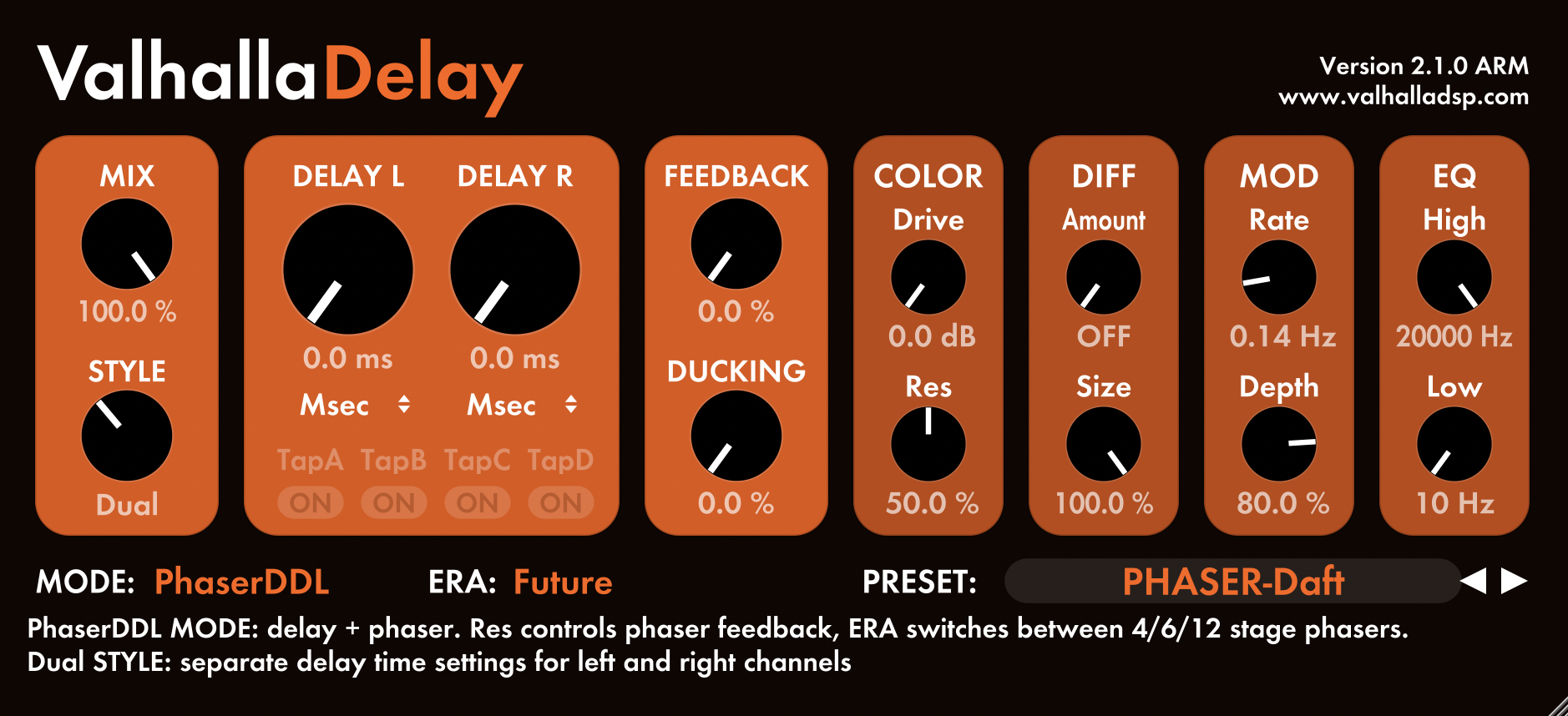
The good news is that the 2.1.0 update also has the two cool new modes introduced with the 2.0.8 update, Quartz and PhaserDDL! PhaserDDL adds 4/6/12-stage phasers into the mix, and is one of my favorite algorithms ever, as it draws on a lot of influences that got me into electronic music and DSP in the first place. Quartz is a crystal clear digital delay, and is great for emulating “high fidelity” digital delays, as well as stomp box flangers.
We should also mention that ValhallaDelay, like all of the Valhalla plugins, has recently been updated for full native M1 compatibility for Macs! All of the Valhalla plugins are available as native Intel and ARM builds, via a single Universal Binary 2 installer, so they can run on the latest Apple Silicon / M1 Macs, as well as older Intel Macs running OS 10.8 through Big Sur.
We are happy to announce that all of the Valhalla plugins are officiallycompatible for M1 Macs! There’s a lot of confusing terminology around this, so I’m going to restate this sentence in a bunch of different ways:
The Valhalla DSP plugins have been built to run as both native Intel and ARM (Apple Silicon) plugins.
The Valhalla plugins are all now Universal Binary 2 plugins
The Valhalla plugins no longer need Rosetta2 to run on M1 Macs (with a few caveats noted below)
We’ve had the M1 builds of all plugins in user accounts as beta versions since January. A few weeks back, we decided to make this official, so we got rid of the “beta” designations of the installers in user accounts, and also built new demo versions of the plugins as Universal Binary 2 for Intel and Apple Silicon.
So, what does this mean? For starters, any of the following DAWs can now run as native M1 apps, and can host the Apple Silicon / M1 / ARM / Universal Binary 2 builds of the Valhalla plugins:
Apple Logic
Apple GarageBand
Apple MainStage
Bitwig Studio 4
Reaper
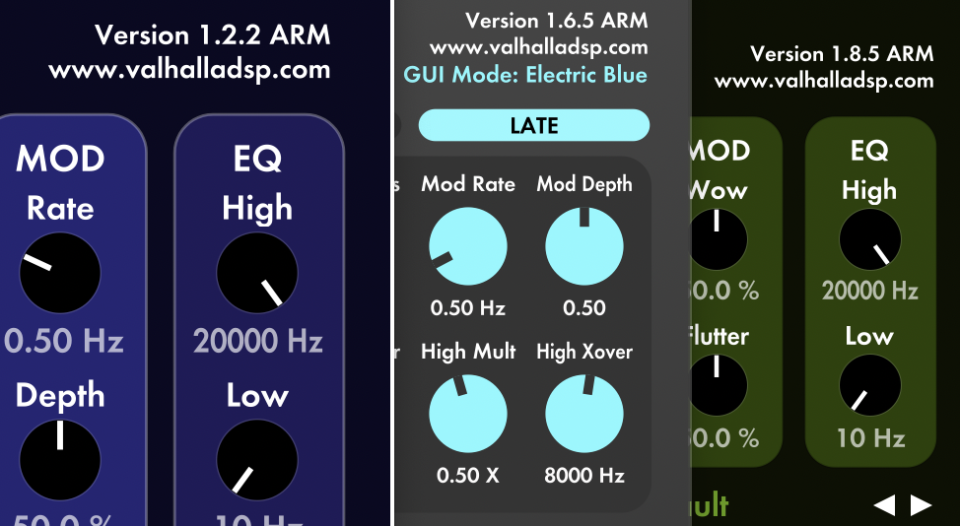
The Valhalla plugins now display “Intel” or “ARM” in their upper right corner, which identifies whether they are running the Intel or ARM build. This is a convenient way of telling whether your DAW is running in Rosetta 2 or as a native Apple Silicon build:
If you are running any other DAW on an M1 Mac, you currently need to run it in Rosetta 2. Additionally, the Valhalla plugin installers require Rosetta 2 in order to install. The plugin builds are UB2, but the installer application itself is a standard Intel installer. It turns out that installers built on Big Sur M1 Macs can only run on the last few Apple OSes, so this choice was made in order to have a single installer work for OS 10.9 through Big Sur.
All of the new Intel / ARM builds work on older Intel Macs as well (that’s the “Universal” part of “Universal Binary 2”). And, of course, all of the plugins work in Windows as well. The M1 updates have just been to the Mac part of the code, so Windows customers aren’t missing out on any cool new features.
On a personal note, I’ve been using an M1 MacBook Air as my main development machine since December 2020. It is blazingly fast, lightweight, and no fan noise. It also makes cross-platform development easy, as all builds on this machine are Intel & ARM by default. If you are looking for a new Mac, I would recommend waiting a few weeks to see what is announced at WWDC, as the next generation Apple Silicon machines may be announced at that time. In any case, I am loving using my M1 MacBook Air right here and now!
Today (May 19th, 2021) marks the one-year anniversary of the release of ValhallaSupermassive! To celebrate, I want to show you a quick and simple way of getting infinite or “freeze” reverbs out of Supermassive.
What’s an infinite reverb?
The idea behind infinite reverbs dates back to the early days of algorithmic reverberators. In your typical algorithmic reverb, you have a bunch of digital delay lines arranged in various series & parallel configurations. Feedback is applied to part of the network. The more feedback is applied, the longer the reverb time. When the feedback gain reaches 0 dB (i.e. a gain of 1.0), the reverb will theoretically go on forever, and you have an infinite reverb.
In reality, some reverb algorithms are better suited for truly infinite reverbs than others. In order to sound realistic, most reverbs have lowpass filters in their feedback loops, to create a more realistic decay. These lowpass filters can continue to filter away the high frequencies when the feedback gain is at 0 dB, which results in the “freeze” reverb becoming duller and more muted over several minutes. Reverb modulation can also cause a loss of high frequencies over time, depending on how it is implemented. The modulation can also cause the signal to turn into a cluster of sidebands, where the original pitch can no longer be perceived.
ValhallaSupermassive was designed to be a bright reverb from the get-go. It uses modulation with no filtering, and most of the algorithms have their low cut and high cut filters outside the feedback path. The filter location was chosen in order to emphasize some of the weird artifacts with low Warp settings, but it also makes these algorithms ideal for infinite reverbs!
Here’s how to infinite reverb in Supermassive:
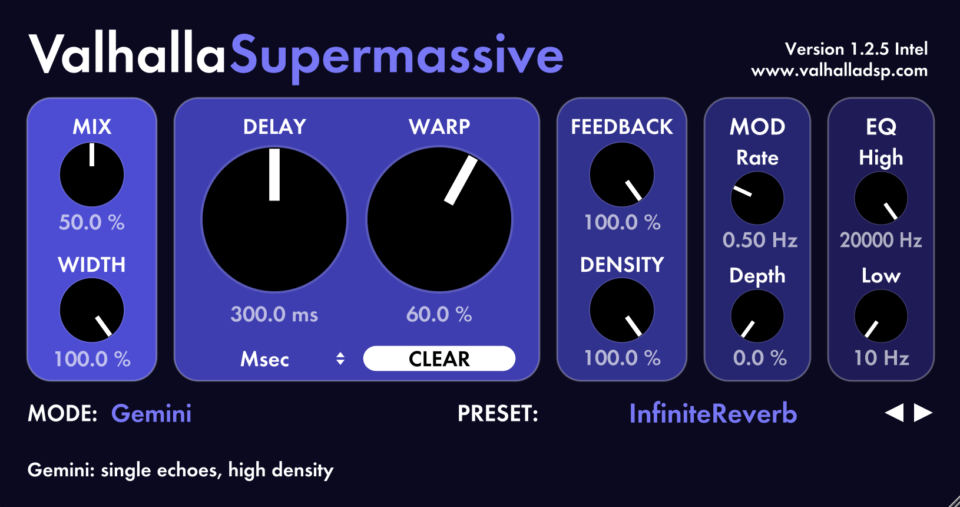
Start with an algorithm that can generate infinite reverb. This may not be obvious from the algorithm names, so here’s a quick list: Gemini, Hydra, Great Annihilator, Lyra, Capricorn.
Set WARP to some non-zero setting, so that you get a reverb sound, versus a repeating echo.
Set DENSITY to some non-zero setting, to smooth things out into reverb.
Turn the Mod Depth to zero. This helps preserve the pitch of the freeze reverb.
Finally, and most importantly, turn the FEEDBACK up to 100%.
Once you’ve done this, play a sound into Supermassive, and listen to that infinite decay!
Here’s an example freeze preset. Feel free to use this as your starting point, switching between the algorithms listed above, and adjusting WARP, DELAY, DENSITY, and the tone controls to your taste:
Supermassive Infinite Reverb Preset
Here’s the above preset in .vpreset format. To use this in Supermassive, select all the text (including the < and > tags at the beginning and end), select COPY (Cmd+C on Mac, CTRL+C on Windows), click on the name of the active preset in the Supermassive GUI, and select “Paste from clipboard.”
The infinite/freeze reverbs in Supermassive will have their own internal “motion” or beat patterns, depending on the algorithm used and the setting of DELAY. Larger delays will result in beat patterns that take longer to repeat.
If you want to add more motion to the sound, simply add the modulation/filtering plugin of your choice after Supermassive. In this example, I am running the Prophet-10 through Supermassive using the above InfiniteReverb preset. Halfway through the track, I fade in a slow stereo phaser (using the new PhaserDDL mode in ValhallaDelay):
Infinite reverbs are a cool trick, but they can be a powerful compositional element as well! Next week, I’ll show you how to use infinite reverbs from Supermassive as the building blocks for massive sounding pads.
This is of my favorite concepts is from Oblique Strategies, a creative-unblocking tool created by Brian Eno and Peter Schmidt back in the day. I feel this can be extended to all areas of music, whether it is minimalist music made from playing the same phrase repeatedly, the “process” music created by playing through a looping delay, the repeating sequences of electronic music, and so forth.
Reusing and Reworking help plugin design.
The area where “reusing and reworking” has had the biggest impact is in my algorithm creation. I’ve been working on reverb algorithms since 1999. I’ve found myself iterating over some of the same ideas over and over in the last few decades, reworking and revisiting them until they finally either find a home in one of my plugins or are put back on the shelf.
ValhallaSupermassive is a real-world example.
ValhallaSupermassive is a great example of this. The algorithms in Supermassive started off as an exploration of some of Michael Gerzon’s reverberation ideas, which I was first introduced to back in 2001. These algorithms can result in a quick build of echo density and were great for experimental reverb sounds, but I always found them unwieldy when putting them into a more general-purpose reverb algorithm. I revisited these algorithms many times over the years, playing with them and keeping them on the back burner.
In early 2020, I was invited to give a few guest lectures at the University of Victoria. I prepared a series of Max4Live patches to illustrate the basic principles of reverb design. Most of these were very simple, but a few sounded nice. When I returned back home, I kept experimenting with these designs and created a simple C++ framework to explore them in detail.
Once these had been ported to C++, I could extend them with the Michael Gerzon ideas that I had played with in the past. The end results sounded weird and awesome but were still unruly and difficult to tame. The solution was easy: Give up “well behaved” as a goal and let it be weird!
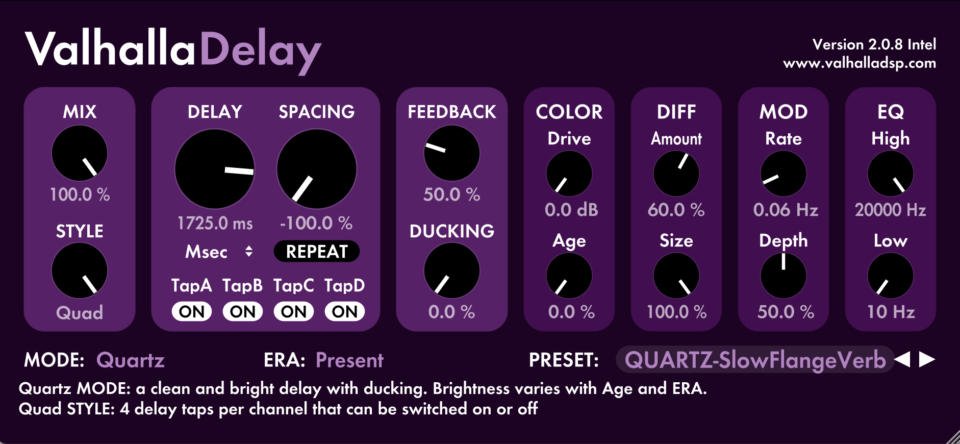
The ValhallaDelay 2.0.8 update introduced two new delay modes, Quartz and PhaserDDL. I’ve talked extensively about the PhaserDDL mode, so I figured I’d do the same for the Quartz mode.
Feature Overview
At its heart, the Quartz mode is a clean and bright digital delay, with smoothed triangle modulation. It shares some similarities with the Clarity mode, but with a few key differences:
The Age control in the Quartz mode controls a steep lowpass filter, but with lower orders (i.e. less filtering of the high frequencies) than the Clarity mode. When ERA is set to Future, the Quartz mode disables the filter.
The Quartz mode has a soft knee limiter controlled by Drive, as does the Clarity mode, but the Quartz mode has less dispersion in the limiter. This allows for signals to loop through the delay continually, without getting “chirpy” or blurred – unless you want blur, in which case the Diffusion section can smooth things out for you.
The EQ filters (Low Cut and High Cut) and the Age filter are outside of the feedback loop in the Quartz mode. This is a technique I used in most of the ValhallaSupermassive modes. The sonic results: a VERY bright delay sound, where the brightness doesn’t roll off over time.
So, what is Quartz best for?
80s/90s digital delays. Most of the “classic” digital delays from the mid-80s and later didn’t have any filters in their feedback path, and the signal quality was high enough that the repeated signal was essentially a delayed copy of the input signal, without much color to speak of.
Stompbox style flangers. Compact flanger pedals tend to use a BBD, running at very high clock rates. This gives you a flanging signal with plenty of high frequencies, especially as you crank up the feedback.
Looping! If you are looking for a looper that sounds like a straight repeat of your signal, Quartz is perfect. The signal will decay away over several minutes, without any loss of high frequencies, and with a minimum of blurring.
Bright reverbs. Turn up the Diffusion amount and size, and Quartz can make some lush reverbs, where the amount of high frequencies is a function of the brightness of the input signal. This works great with an analog synth, where you are riding the lowpass filter cutoff.
Here’s a few examples of the Quartz mode processing drum samples. In the first example, I’m using DMX samples, and the Quartz mode is used for stereo widening of the clap, for the flanging on the toms/hi hats/rimshots, and for a flanged eighth note echo using the Quad style for some deep through-zero flanging:
In the second example, Don Gunn programmed Linn drum samples in Live. He’s using Quartz for the snare reverb, the flanging on the toms, and widening of the clap sound:
We use cookies to ensure that we give you the best experience on our website. If you continue to use this site we will assume that you are alright with it.